
Scientists confirm: This is the most effective way to get your cat’s attention, according to new research
Elderly Couple Refuses Reserved Seats—Viral Train Standoff Sparks Fiery Debate on Courtesy
Just like last year, Xiaomi is updating its mid-range smartphones with three new models: the Redmi Note 15 (available in 4G and 5G versions), the Redmi Note 15 Pro (only 5G in our market), and the Redmi Note 15 Pro+ (also 5G, of course).
As we’ll explore, the Xiaomi Redmi Note 15 Pro 5G differs from the Redmi Note 14 Pro 5G, which we tested at the beginning of last year, in several technical aspects: design, processor, screen size, and battery capacity.
However, in terms of software, the manufacturer hasn’t made much progress. Thus, besides a new version of Android (not the latest, though!), AI is still mainly limited to photo editing.
Do these changes make the Redmi Note 15 Pro 5G a must-have smartphone in a price range of around 400 euros? Let’s find out in detail.
Technical Specifications
| Model | Xiaomi Redmi Note 15 Pro 5G |
|---|---|
| Dimensions | 78.09 mm x 163.6 mm x 7.96 mm |
| Screen Size | 6.83 inches |
| Resolution | 2772 x 1280 pixels |
| Pixel Density | 447 ppi |
| Display Technology | AMOLED |
| SoC | Mediatek Dimensity 7400-Ultra |
| GPU | Mali G615 |
| Internal Storage | 256, 512 GB |
| Rear Camera |
Sensor 1: 200 MP Sensor 2: 8 MP |
| Front Camera | 20 MP |
| Wi-Fi | Wi-Fi 6E |
| Bluetooth | 5.4 |
| 5G | Yes |
| NFC | Yes |
| Fingerprint Sensor | Under the screen |
| Connector Type | USB Type-C |
| Battery Capacity | 6580 mAh |
| Weight | 210 g |
| Colors | Blue, Gray, Purple |
| Product Sheet |
Design: More Angular
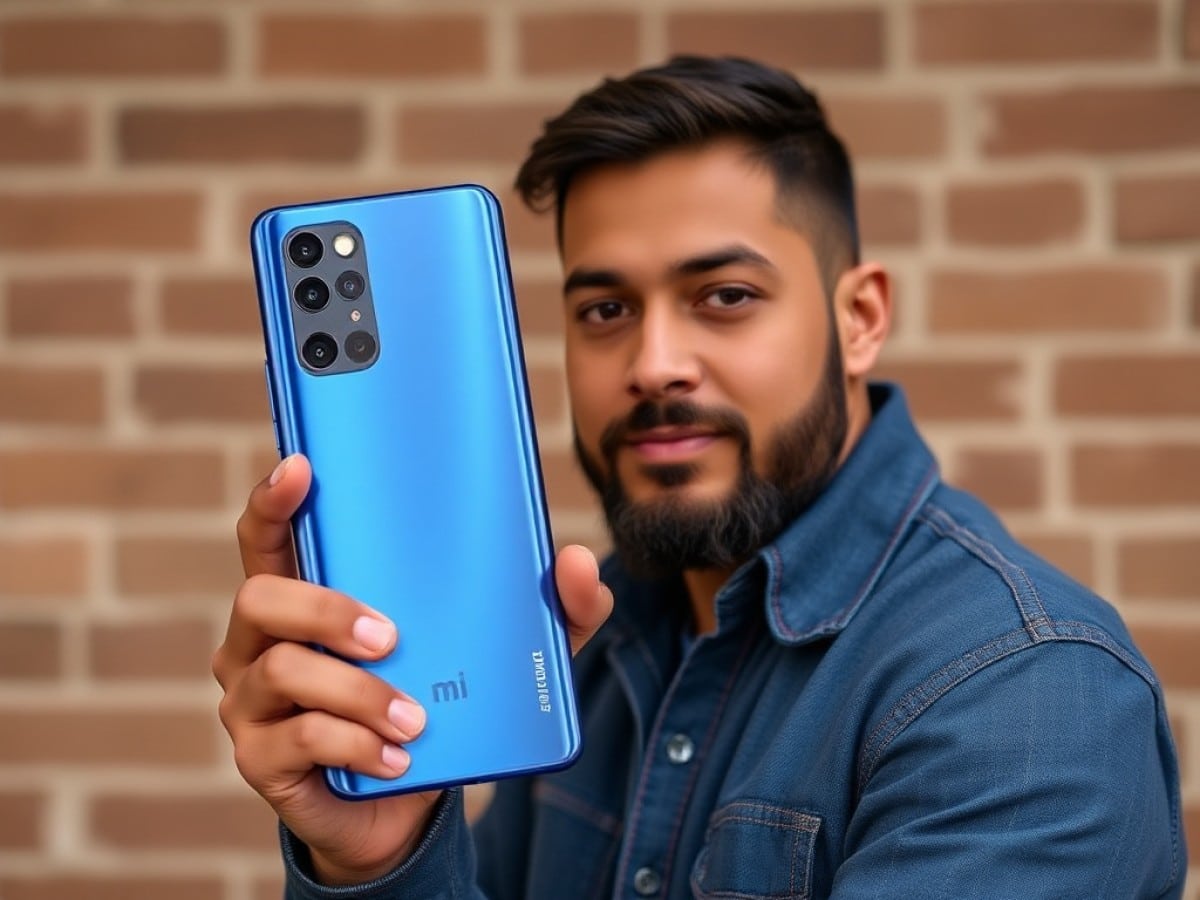
The Xiaomi Redmi Note 15 Pro 5G is available in four colors: glacier blue, violet, black (like the Redmi Note 14 Pro 5G), plus a new one called titanium (model tested). Aside from the name, this does not indicate the use of titanium in the chassis’s composition.
Indeed, the frame of the smartphone is made of plastic, as is its back. The latter also features a matte texture, which is quite pleasant and barely shows fingerprints (at least for the version provided to us by the manufacturer).
Nevertheless, Xiaomi claims that its smartphone can withstand a fall from 2.5 meters without damage.
The screen, meanwhile, is protected by Gorilla Glass Victus 2 glass, similar to a more premium smartphone like the Samsung Galaxy S25. Lastly, the internal components of the Redmi Note 15 Pro 5G are safe from water and dust since the smartphone is certified IP68 and can therefore be submerged without fearing malfunction.
There’s no change compared to the Redmi Note 14 Pro 5G. The same goes for the rounded, centered camera module. Otherwise, the Xiaomi Redmi Note 15 Pro 5G measures 16.3 x 7.8 x 0.8 cm, with a weight of 210 grams.
Security is ensured by a fingerprint reader, placed under the OLED panel (an option allows unlocking the smartphone by facial recognition if preferred).
And as the trend lately is towards “all flat,” Xiaomi changes its approach once again. Indeed, while the Redmi Note 14 Pro 5G had abandoned the flat edges of its predecessor for rounded edges, this year’s model returns to them.
Flat edges, flat screen, flat back… While it would be exaggerated to say that the Redmi Note 15 Pro 5G is very flat, it must be acknowledged that originality is not its strong suit. To its credit, several manufacturers have succumbed to this trend in 2025, and it’s likely to continue this year since curves are evidently out of favor.
Screen: Bigger and Brighter
The Xiaomi Redmi Note 15 Pro 5G stands out from its predecessor with an OLED panel of 6.83 inches diagonally. It is therefore slightly larger than that of the Redmi Note 14 Pro 5G (which was 6.67 inches).
The images are displayed at a resolution of 2772 x 1280 pixels (finer than the 2340 x 1080 pixel mode of the Samsung Galaxy A36 and Galaxy A56), with a maximum refresh rate of 120 Hz.
It’s noted that the screen benefits from a treatment that allows it to be used without problems in the rain, with a wet index.
According to Xiaomi, the maximum brightness of the Redmi Note 15 Pro 5G’s screen can reach 3200 nits in HDR peak.
To verify this, among other things, we used a Calibrite Display Pro HL probe and CalMAN Ultimate software from Portrait Displays.
First lesson, in standard mode, the maximum brightness peaks at around 600 nits (both in SDR and HDR), which is an average result. However, if you activate automatic brightness, to benefit from better readability in full sun for example, the maximum brightness is much better:
- 1140 nits in SDR
- 3154 nits in HDR (significantly better than the Redmi Note 14 Pro 5G). This is an excellent result, on par with the brightness observed on the Xiaomi 15T and Xiaomi 15T Pro, which are much more expensive.
Also, the average Delta E measured is almost equal to 3 (3.02 to be exact), which indicates that the screen displays colors that perfectly correspond to the optimal theoretical shades.
The overall colorimetry, meanwhile, proves to be highly neutral, since the color temperature was measured by default at 6970 K (the colors lean slightly towards blue). To correct this, you can use the Warm setting, which brings the average color temperature to 6383 K, which is very close to the 6500K value, symbolizing perfectly neutral colorimetry.
Finally, the OLED panel is capable of reproducing the entire DCI-P3 color space (116% in this case), which is an excellent point. The BT.709 and BT.2020 gamuts are covered to the extent of 173% and 78%, respectively.
It is also worth mentioning that the screen is certified Dolby Vision and HDR10+, ensuring optimal visual quality when watching a movie or series on streaming, no matter which VOD service you subscribe to.
Performance: A More Capable GPU
In terms of computing power, the Xiaomi Redmi Note 15 Pro 5G does not succumb to the temptation to use a Qualcomm chip and still features a Mediatek processor, the Dimensity 7400 Ultra, in this case. This chip integrates 8 cores, 4 of which operate at 2.6 GHz (2.0 GHz for the other 4), as well as the GPU Mali-G615.
How does this model differ from the Dimensity 7300 Ultra that powered the Redmi Note 14 Pro 5G? Not much, regarding the CPU part! Indeed, the 4 fast cores have a frequency that is only 100 MHz higher. However, on the GPU side, the operating frequency has been significantly boosted, from 1047 MHz to 1300 MHz.
And this explains the results obtained. Indeed, we observe that the gain in performance between the two smartphones is minimal in terms of CPU computing power. Thus, the Antutu v10 score goes to 695658, compared to 677088 for the Dimensity 7300 Ultra (less than 3% better). The same goes for the Geekbench scores, which only evolve very slightly for single and multi-core calculations.
However, the Geekbench graphics score increases significantly, from 2500 to 3039, or about 20% better. And the increase is of the same order, about 20%, if we look at the results obtained with the Wild Life Extreme test of the 3D Mark benchmark: 1008 for the Redmi Note 15 Pro 5G, compared to 848 for the Redmi Note 14 Pro 5G.
If we compare the scores obtained by the Dimensity 7400 Ultra and those of the Qualcomm Snapdragon 6 Gen 4, found in the Honor Magic 8 Lite, we are almost in the same magnitude, both in terms of calculations and for graphic performances (Wild Life, Wild Life Extreme, and Geekbench). However, it is noted that the Mali-G615 of the Dimensity 7400 Ultra obtains slightly higher scores with some 3D Mark tests:
- Steel Nomad Light (1440p performance)
- Sling Shot and Sling Shot Extreme
Finally, compared to the Exynos 1580 from Samsung, present in the Galaxy A56, the Mediatek chip does not hold up. Indeed, the Exynos offers better performance across the board.
Of course, the Dimensity 7400 Ultra is perfectly suited to a smartphone like the Xiaomi Redmi Note 15 Pro 5G, as it always responds promptly, in the context of office and multimedia use.
And, even when it comes to relaxing, the Xiaomi Redmi Note 15 Pro 5G performs honorably. For example, if you install the game Fortnite, the 60 frames per second option is accessible in Epic quality (the best). But, in practice, the counter mostly tops out at around forty frames per second. That’s already not bad.
On a positive note, even in this intense gaming context, the processor’s performance remains almost constant (only a 5% drop), while its temperature remains very reasonable (50 degrees).
Software: More? Oh no, no changes…
In terms of software, broadly speaking, it’s like last year with the Xiaomi Redmi Note 14 Pro 5G, but with Android 15 (you’ll have to wait for an update to get Android 16!) and the HyperOS 2 interface.
System updates are still guaranteed for 4 years (6 years for security updates).
Thus equipped, the software environment of the Xiaomi Redmi Note 15 Pro 5G proves to be pleasant, with the possibility of having floating windows and a split screen (two applications displayed simultaneously).
Not to mention, of course, Google’s Gemini assistant, as well as the Surround to Search function.
However, one might criticize the manufacturer for not really making a leap forward, since the previous version, in terms of AI (it’s rather a vertical leap!).
Indeed, we regret the absence of advanced tools for translation/transcription assistance. Indeed, these tools (AI Writing, AI Interpreter, AI Voice Recognition, etc.) are reserved for the big brother of the Redmi Note 15 Pro 5G, the Redmi Note 15 Pro+ 5G.
However, the AI options for photo editing are comprehensive: image extension, sky modification, magic eraser, object cutout and displacement, Ultra HD, reflection removal.
Photography: Still No Telephoto Lens
The only new photographic feature offered by the Xiaomi Redmi Note 15 Pro 5G is the disappearance of the macro lens (which won’t be missed by many!).
Otherwise, we find exactly the same equipment, two rear lenses and one front lens for selfies, as on the Xiaomi Redmi Note 14 Pro 5G.
It’s noted that there’s no special mode that needs to be activated when lighting conditions are unfavorable. This is explained by the fact that – at night – the exposure time is automatically increased, regardless of the focal length and sensor (rear or front) used.
Wide-Angle
The main lens corresponds to a wide-angle, equivalent to a 23 mm focal length, with an aperture of f/1.7. It is associated with a 200-megapixel sensor, which features an optical stabilization system, to minimize blurry photos.
Since the sensor uses 16-in-1 Pixel Binning technology (to capture maximum light in all circumstances), the images are generated at 4080 x 3060 pixels.
As can be seen in these few examples, the images are precise and the lighting ambiances are perfectly rendered.
At night, the sensor manages to produce rather satisfactory images. The precision is not breathtaking or assured, as you must remain perfectly still during the exposure time. However, even when you are far from any light source (see the photo of the statue in
Similar Posts
- Xiaomi Redmi Note 15 Pro+ Review: A Convincing Smartphone Challenged by Xiaomi’s Classics
- Xiaomi 15T and 15T Pro Launch Date Revealed: Here’s What We Know!
- Xiaomi Smartphone Users Rejoice: Get HyperOS 3 Before Everyone Else!
- Xiaomi 15T Pro Review: Experience Luxury Features Without the High Price!
- Xiaomi Redmi Pad 2 Pro Review: Balanced Tablet with Some Flaws

Maya Singh is a senior editor covering tablets and hybrid devices. Her work explores how these tools reshape digital productivity and learning. She also contributes to feature editorials on emerging tech.