
Scientists confirm: This is the most effective way to get your cat’s attention, according to new research
Elderly Couple Refuses Reserved Seats—Viral Train Standoff Sparks Fiery Debate on Courtesy
Mercedes is actively updating its electric vehicle lineup. After the CLA, GLB, and GLC, it’s now the turn of the C-Class to go electric, potentially replacing the Mercedes EQE in the lineup.
After an initial static introduction, we had the chance to drive this electric C-Class in Finland. You’ll find that it holds several advantages over its competitors, such as the BMW i3 and the Audi A6 e-tron.
Technical Specifications: The Best of Mercedes
| Model | Mercedes-Benz C-Class |
|---|---|
| Dimensions | 4.88 m x 1.89 m x 1.50 m |
| Power (hp) | 489 hp |
| 0 to 100 km/h | 4.0 s |
| Level of Autonomy | Semi-autonomous driving (level 2) |
| Max Speed | 210 km/h |
| Embedded OS | MB.OS |
| Main Screen Size | 39.1 inches |
| Car Side Plug | Type 2 Combo (CCS) |
|
Try it |
Product Sheet |
Design: Distinctively Mercedes
The previous generation of Mercedes electric vehicles had somewhat confusing designs. The company had opted for ultra-aerodynamic cars prioritizing efficiency over traditional brand aesthetics.
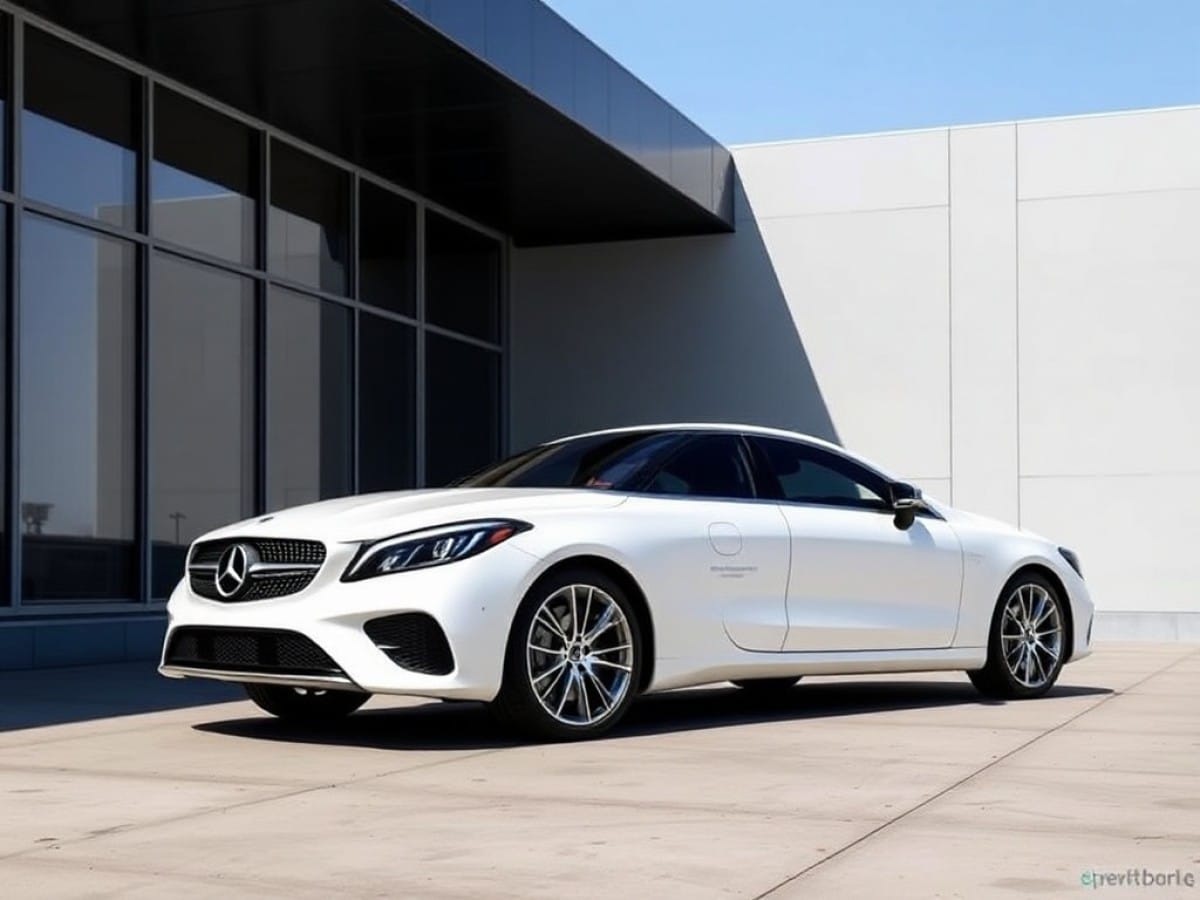
In this new Mercedes C-Class 400 EQ, the manufacturer retains the highly aerodynamic silhouette of the Mercedes EQE but has redesigned the front with a new grille derived from the Mercedes GLC. This grille slightly protrudes from the rest of the bumper, and the inspiration seems to come from the Mercedes 600 W100—a significant reference given the iconic status of the Mercedes 600 in automotive history.
This prominent grille is illuminated at night by white LEDs, as is the star emblem, which is now integrated into the grille instead of being mounted on the hood as in previous C and E Classes. The drag coefficient is 0.22, which enhances efficiency.
From the side, the flush door handles are noticeable. They extend and retract automatically thanks to a small electric motor.
At the rear, a black strip runs across the trunk, and a light signature in the shape of four Mercedes stars is visible, similar to those found in the front headlights.
The Mercedes C-Class 400 4MATIC is an elegant three-box sedan measuring 4.88 m long, 1.89 m wide, and 1.50 m high. Importantly, the Mercedes C-Class has grown considerably: at 4.88 m in length, it is 13 cm longer than the current C-Class with internal combustion engine and only 6 cm shorter than the Mercedes E-Class with internal combustion engine.
Spaciousness: Plenty of Room Inside
With a length of 4.88 m and a wheelbase of 2.96 m, the Mercedes C-Class offers ample space inside. Front passengers are comfortably seated in seats that strike a good balance between comfort and support.
In the rear, the bench seat is welcoming for adults, who will find plenty of legroom and headroom. Rear passengers benefit most from the panoramic sunroof with liquid crystals that can be made opaque. It is also possible to display a pattern of backlit Mercedes stars in this glass roof.
As for the trunk, it offers 470 liters of space. The rear bench seat is foldable, and it’s possible to lower only the middle seat to slide in items like skis. However, the trunk is a trunk and not a hatch, which makes it slightly more challenging to load large objects.
Under the hood, a front trunk adds 101 liters of storage space. Its opening is easy, as the Mercedes emblem at the end of the hood actually serves as a release button. Then, simply pull on the handle located under the hood, which is easily accessible, to open it with the help of struts.
Beyond just space, the choice of materials deserves praise. Whether it’s the leathers, plastics, or metals, all the elements integrated into our Mercedes C-Class AMG Line are impressive.
Without a doubt, Mercedes remains at the top of the hierarchy among premium car manufacturers. Moreover, the manufacturer is also focusing on its infotainment system to offer a unique immersive experience.
Infotainment: A Real Showstopper
I’m now accustomed to cars that feature modern infotainment systems, sometimes with three screens, including one for the passenger. But none has impressed me as much as Mercedes’ system.
Our model was equipped with the 39.1-inch MBUX Hyperscreen, which is borderless. Standard models come with three screens, but they have borders. The borderless Hyperscreen option costs about 1,500 euros and is highly recommended.
The front passengers face a single large screen that includes the gauge cluster, infotainment, and passenger screen. The screen’s responsiveness is outstanding; it reacts well to both touch and voice commands through the continuously improving AI “Hey Mercedes”. The screen’s resolution is excellent, as are the color contrast and brightness.
While the screen is impressive, some functions can be irritating, like the lack of steering wheel controls for changing music. You have to tap a small button on the touchscreen by stretching your arm, as the screen is actually a bit far from the driver, depending on their seating position.
Mercedes indicates that it’s possible to change the media being played using the voice assistant, but I don’t necessarily want to say “Hey Mercedes, skip to the next song” every time.
On the other hand, this voice assistant is intelligent. For example, you can ask it to search for a type of restaurant nearby or at your destination, make a reservation, then find parking or a charging station, specifying whether you want a fast charger or not. All this works thanks to Google’s knowledge base.
Of course, you can also use smartphone replication via Android Auto or Apple CarPlay wirelessly. There are also two wireless charging pads for smartphones. Finally, two USB-C ports are hidden under the floating central console, and two more are available for rear passengers at the back of the central armrest.
Driving Aids: Enhancing Safety
Mercedes showcased its research on driving aids. The Mercedes C-Class 400 is equipped with 27 sensors distributed around the vehicle, with a specific computing unit hidden in the left rear fender to coordinate everything. The system is so advanced that this computing unit must be water-cooled through a watercooling system.
All this is designed to offer increasingly safer driving aids. During the test, Mercedes simulated several everyday situations prone to accidents, such as crossing an intersection or a pedestrian crossing hidden behind a vehicle, to demonstrate the capabilities of the PRE-SAFE system.
Regarding autonomous driving, Mercedes offers an advanced system with features like the Distronic cruise control, which adapts to the speed of the vehicle ahead or the current speed limit. The lane-keeping assist is effective and prevents the car from deviating from its lane.
The car also accurately follows the road in curves. It’s also possible to equip the electric Mercedes C-Class with the MB.Drive Assist system with lane change assistant, which handles lane changes with a simple flick of the turn signal lever.
Route Planner
It’s no surprise that the Mercedes C-Class 400 is equipped with a route planner. This feature has become essential for all electric vehicles intended for road use.
It allows for planning long journeys with the vehicle’s navigation system, which takes into account the electric consumption, distance, and available charging stations along the route to provide the best travel time to the destination.
You can of course adjust the desired battery percentage at chargers and upon arrival to suit your needs.
Driving: The Sportiest C-Class Yet?
Mercedes claims that the new electric C-Class is the sportiest C-Class yet. This statement might raise eyebrows considering it is the largest and heaviest C-Class in the model’s history.
However, Mercedes has made efforts to minimize the impact of the vehicle’s size and weight while driving. The rear wheels can turn up to 4.5 degrees. This makes the car feel almost snake-like at low speeds, but above all, very agile for making U-turns (turning radius of 11.2 m) and very responsive at the wheel in faster corners. Indeed, from 70 km/h onwards, the rear wheels turn up to 2.5 degrees in the same direction as the front wheels.
The Airmatic air suspension also contributes to the dynamics, as it intelligently manages the ride height based on Google Maps navigation data. A lower car is generally more dynamic and more efficient. The control of this suspension also relies on data recorded by other Mercedes cars via the Car-to-X technology and transmitted in real time to the Mercedes-Benz Intelligent Cloud. This function is particularly handy when approaching a speed bump.
If this suspension contributes to the dynamism of the electric Mercedes C-Class, it can also be very soft in Comfort mode. It offers a real smoothness that favors comfort, this time at the expense of dynamism, as the car tends to sway on bumps. To find the right compromise, you need to play with the suspension settings.
To be honest with you, we couldn’t really exploit the acceleration qualities of the Mercedes C-Class 400. Finnish roads are very straight, not conducive to changes of pace, and the presence of numerous speed cameras discourages speeding.
But on a few fast road insertions, we were able to enjoy the 489 horsepower and 800 Nm of torque. The acceleration is truly breathtaking, with a 0 to 100 km/h time of 4 seconds, almost giving the impression of having more power.
This is due to the two-speed transmission on the rear axle. The first gear, with a ratio of 11.1, ensures good acceleration and a towing capacity of 1.8 tons, while the second gear favors steady-speed driving to improve efficiency.
The gear change is almost imperceptible and its timing depends on the driving mode, the battery charge level, or the driver’s behavior.
Finally, to make it the sportiest of the Mercedes C-Class, the manufacturer has also worked on the braking system. The new monoblock braking system optimizes energy recovery during braking with a deceleration power of 300 kW. The pedal feel is not spongy, unlike some other electric cars. There is a One-Pedal driving mode that can be activated with the steering wheel paddles. It is indeed possible to completely do without the hydraulic braking system.
These paddles also serve to switch from one energy recovery level to another. However, I find that there is a missing intermediate level between the strongest decelerations and the normal mode.
The Mercedes C-Class 400 4MATIC is then a perfect synthesis between dynamism and comfort. The manufacturer has perfectly played with the driving modes and the air suspension to offer this compromise. Finally, the perfect soundproofing allows you to enjoy the Burmester audio system
Range, Battery, and Charging
This Mercedes C-Class 400 4MATIC uses a 94 kWh battery in its launch version. It powers two motors, one on the front axle and one on the rear, giving it all-wheel drive. By using a few tricks like disconnecting the front motor and the two gears for the rear motor, the range can reach up to 762 km according to the WLTP cycle.
The WLTP consumption figures are announced between 14.1 kWh and 18.5 kWh/100 km depending on the configuration. Note that a more sporty tire fitment is offered, which increases consumption in favor of dynamism.
Durin
Similar Posts
- Skoda Epiq Review: Discover Volkswagen’s Most Affordable SUV Starting at €25,000!
- Mercedes-Benz CLA Shooting Brake Review: Discover the Ultimate in Style and Performance!
- Tested: New Mercedes CLA Shooting Brake – Stunning Electric Wagon, Nearly Perfect But Flawed!
- Tested: The Electric Mercedes GLB Makes Family Vacation Departures a Breeze!
- Dacia Spring Review: Is France’s Cheapest Electric Car Still Overpriced?

Maya Singh is a senior editor covering tablets and hybrid devices. Her work explores how these tools reshape digital productivity and learning. She also contributes to feature editorials on emerging tech.