
Scientists confirm: This is the most effective way to get your cat’s attention, according to new research
Elderly Couple Refuses Reserved Seats—Viral Train Standoff Sparks Fiery Debate on Courtesy
Garmin has a well-established annual schedule. Every year, during the back-to-school season, the sport watch brand introduces a new model to its Fenix lineup. Following the launch of Fenix 7 three years ago, Fenix 7 Pro in 2023, and Fenix 8 last year, it’s time for the new Fenix 8 Pro.
This year’s lineup includes Garmin watches that carry over the main features from the 2024 Fenix 8 but with significantly enhanced connectivity. This is a comprehensive review of the new Garmin Fenix 8 Pro.
Note: Since many features are similar between the Fenix 8 Pro and the Fenix 8 Amoled, we also recommend checking out the review of the Fenix 8. Here, we will focus primarily on the new features, specifically connected features, battery life, and connectivity.
Garmin Fenix 8 ProTechnical Specifications
| Model | Garmin Fenix 8 Pro |
|---|---|
| Dimensions | 47 mm x 47 mm x 16 mm |
| Technology | Li-Ion |
| Screen Resolution | 454 x 454 pixels |
| Panel | AMOLED |
| Internal Memory | 32 GB |
| Weight | 77 g |
| Heart Rate Sensor | Yes |
| Sleep Analysis | Yes |
| Accelerometer | Yes |
| Ambient Light Sensor | Yes |
| Protection Rating | 10 ATM |
| Product Sheet |
The watch for this review was provided by the manufacturer.
Garmin Fenix 8 ProA Bulky Watch That Gains Even More Thickness
At first glance, it’s hard to distinguish the new Garmin Fenix 8 Pro from the previous Garmin Fenix 8.
Garmin has chosen to use a similar-looking case with the same dimensions, the same bezel around the screen, and a very similar design. Here are the two sizes available:
- Garmin Fenix 8 Pro 47 mm: 47 x 47 x 16 mm, 56 grams
- Garmin Fenix 8 Pro 51 mm: 51 x 51 x 16.5 mm, 65 grams
It’s worth noting that Garmin chose not to offer a 43 mm version of the Fenix 8 Pro this year, unlike last year. In terms of sizes, the Fenix 8 Pro microLED is only available in a 51 mm size.
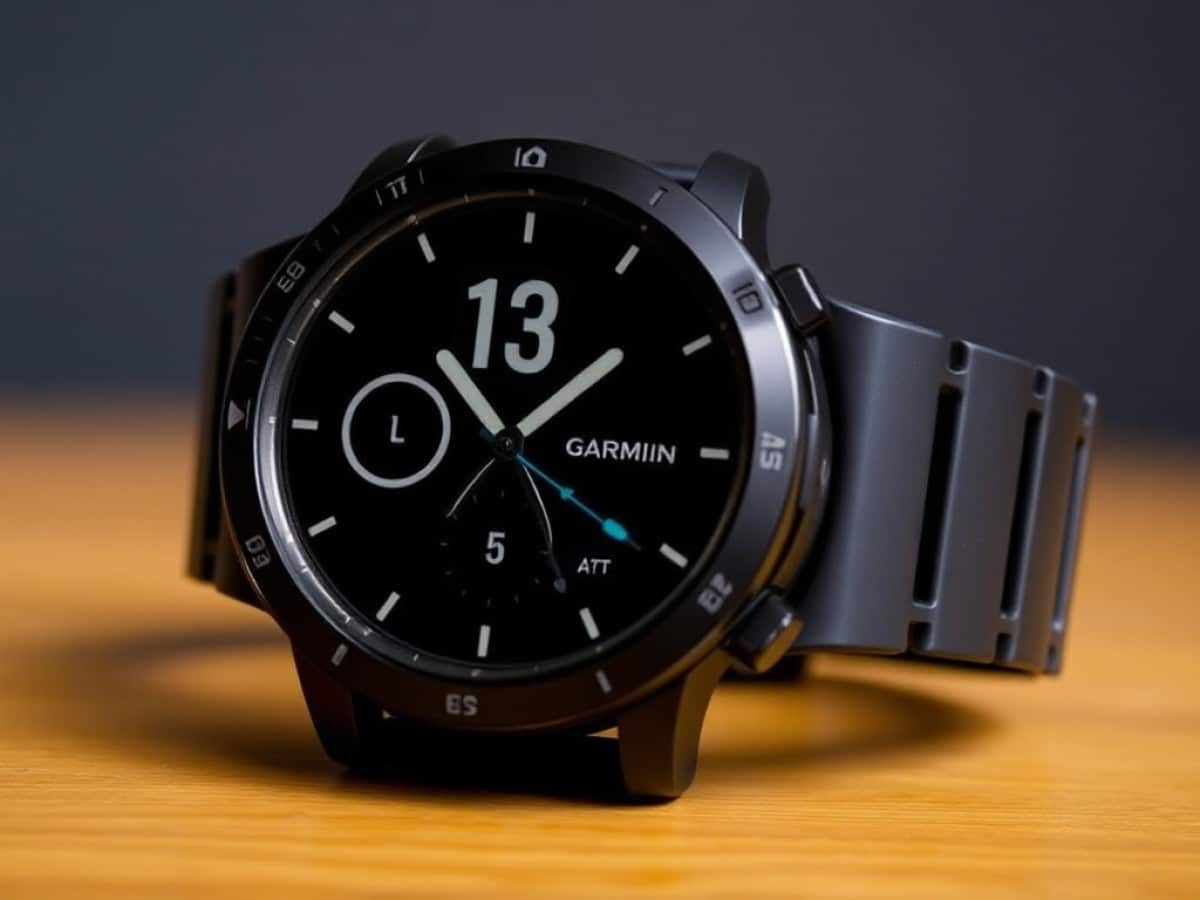
In my case, I tested the 47 mm Amoled version of the Fenix 8 Pro. Essentially, as with the Fenix 8, this is a rather bulky case whose design with visible screws strongly emphasizes the watch’s outdoor focus. It’s the thickness, compared to a Forerunner 970, for instance, that might make it somewhat uncomfortable to wear, especially for sleeping or in winter when you want to layer clothes such as a shirt, a sweater, and a coat. Moreover, the watch is slightly thicker than the already quite bulky Fenix 8, with an extra 2.2 or 1.8 mm depending on the size.
While the Fenix 8 Pro follows the general design of the Fenix 8, it is differentiated by some visual elements. Notably, the start/stop button positioned at two o’clock and highlighted in red. This shade is also found on the bezel around the screen at the same location. Additionally, the microLED version includes a protective shield that uses the same color.
Otherwise, the watch exudes durability and resilience, with a titanium bezel and back, sapphire glass to protect the screen from scratches, a 10 ATM diving rating, waterproof buttons—which, unfortunately, have the same somewhat soft haptic feedback as the standard version—and the rest of the casing made of plastic to reduce weight.
Regarding the strap, the Garmin Fenix 8 Pro comes with a silicone strap compatible with Garmin’s QuickFit system. Unfortunately, unlike some competitors, the American brand still does not offer nylon straps with the watch. It’s a pity, as nylon straps are much better suited for precise adjustments during sports activities. Fortunately, many other straps, sold by Garmin or third-party manufacturers, are compatible.
Garmin Fenix 8 ProA Brighter Screen… Or Not Much Change
While the original Garmin Fenix 8 was offered both with an Amoled screen and a transflective MIP panel, this year, Garmin has opted to only offer an LED display.
However, two distinct technologies are available. If the standard Fenix 8 Pro uses an Amoled panel similar to those in the Forerunner 970 or Fenix 8, the Fenix 8 Pro microLED introduces a brand-new microLED display technology for connected watches. This allows for increased screen brightness, reaching up to 4500 cd/m². For comparison, the Apple Watch Ultra 3, the Galaxy Watch Ultra, or the Google Pixel Watch 4 are limited to 3000 cd/m², while the Huawei Watch Ultimate 2 tops out at 3500 cd/m².
In my case, however, I had the opportunity to test the Amoled version. Naturally, you’ll have a different diameter and screen resolution depending on the model chosen:
- Garmin Fenix 8 Pro 47 mm: 1.4 inches, 454 x 454 pixels
- Garmin Fenix 8 Pro 51 mm: 1.4 inches, 454 x 454 pixels
Note that the Fenix 8 Pro microLED maintains the same display size and resolution as the 51 mm Amoled model.
For the Amoled model that I tested, we have a classic Amoled panel. Although some reviews suggest that the screen now matches the brightness of the recent Forerunner 970, I must confess that I struggled to see a clear evolution compared to the standard Fenix 8, which I wear on the other wrist. Thus, we have sufficient brightness most of the time, even in full sunlight during outdoor training sessions, but it doesn’t quite reach the peaks offered by recent connected watches like the Google Pixel Watch 4, the Samsung Galaxy Watch Ultra, or the Apple Watch Ultra 3. It’s worth noting that the watch includes an ambient light sensor to adjust the screen lighting to your environment.
The Garmin Fenix 8 Pro also features an always-on display mode that can be scheduled for certain hours, such as from 9 AM to 11 PM, and deactivated during the night.
As for the watch faces, there are fourteen pre-installed models on the watch—with numerous customization options—but it’s also possible to download more through the Garmin Connect IQ app.
Garmin Fenix 8 ProA Watch with 4G Compatibility and Satellite Connection
The features are where the Garmin Fenix 8 Pro stands out the most from the standard Fenix 8.
Of course, the watch retains the traditional functions of Garmin watches, whether it’s connection via the Garmin Connect app or navigation offered both with the five buttons or via the touchscreen. There’s also a very handy flashlight, the ability to make Bluetooth calls, and contactless payment through Garmin Pay.
Why not take advantage of refurbished products during Black Friday? At Back Market, the Apple Watch Ultra costs less than 375 euros with the code KDO2025, valid on all connected watches.
For all these points, I invite you to refer to the test of the Garmin Fenix 8. Here, we will focus mainly on the particularity of the Fenix 8 Pro: its connectivity.
The 4G Functions Offered by the Garmin Fenix 8 Pro
Indeed, the Fenix 8 Pro is the first Garmin watch, since the Forerunner 745 LTE, to offer 4G connectivity. However, unlike the practice for connected watches from Samsung, Google, or Apple, it’s not about using an eSIM plan subscribed with a carrier here.
Instead, Garmin offers several “inReach” plans that you can directly subscribe to in Garmin Connect:
The differences between the different formulas come only from the functions included in case of satellite connection—we’ll get back to this.
In my case, the 4G connectivity mainly allowed me to go running… without my phone. It must be said that I regularly use the “LiveTrack” function of Garmin to automatically send my position, during my training sessions, to my partner, for safety reasons. However, for the watch to share its location, it was necessarily required to have your smartphone with you. Even if I had my music stored locally, I couldn’t run without my phone. With 4G connectivity, this is now possible.
For the other functions offered by 4G, we note messaging or voice calls. However, these are not simple SMS or GSM calls. It’s impossible to call just any phone number or send an SMS to anyone. In fact, these functions necessarily go through Garmin Messenger, Garmin’s messaging application.
Therefore, you can only contact people who have also installed Garmin Messenger on their smartphones, which significantly reduces the usefulness of these features. WhatsApp isn’t for everyone, and of the 384 contacts in my phone book, only four use Garmin’s messaging application. Moreover, only one of them was available for voice calls and, despite about ten attempts, I was never able to reach him. The watch indicated that my contact needed to update his Garmin Messenger app (which was obviously already done) to receive a voice call.
Another point to note: Garmin offers two modes for the 4G connection of its watch, “LTE: enabled” and “LTE: automatic“. In the first case, the 4G connection is activated permanently, at the expense of significantly reduced battery life. In the second, 4G is triggered only when needed—if you make a call, send a message, or share your location with LiveTrack. It’s this second mode that I used during my test, even if it sometimes meant receiving messages a few minutes late.
Regarding the LiveTrack function offered in 4G on the Fenix 8 Pro, a minor downside is also worth noting. While real-time tracking is truly real-time when done through a smartphone, it has noticeable latency when activated from the watch, with a position refresh every minute. Nothing dramatic, but during a race, if you have supporters in the crowd, it means they’ll have to watch out for you a little longer on the course.
The Satellite Functions Offered by the Garmin Fenix 8 Pro
Regarding satellite connectivity, it will automatically take over in cases where the 4G connection is absent. However, it should be noted that the 4G coverage in mainland France is particularly dense, with coverage ranging from 92 to 97% of the territory according to operators—Garmin was unable to tell us which network is used in France for its LTE connection. Switching to a satellite connection will therefore be mainly useful in case of exploration in white zones, for example, when sailing at sea or during a trail or hike in the Écrins Massif in the Alps.
It’s also worth noting that satellite connectivity requires a clear view of the sky and a particular orientation of the watch towards the Skylo satellite constellation, Garmin’s partner. It’s not supported everywhere in the world and is only offered in Europe and the United States, at certain latitudes, as detailed by Garmin on its maps.
Concretely, since the options included in the satellite connection differ between the different inReach plans, it’s better to opt for the “Enabled” subscription at 9.99 euros per month, even if you activate a more advanced subscription, “Standard” or “Premium“, in case of exploration planned in an area where you will no longer have a 4G network.
On a positive note, emergency SOS messages by satellite, which are triggered by pressing and holding the upper left button, will work with all inReach plans.
Garmin Fenix 8 ProSport Functions Similar to the Standard Model
In terms of different sensors for health and training monitoring, the Garmin Fenix 8 Pro incorporates the same sensors as the standard model, including a dual-frequency GPS chip, a Gen 5 Elevate optical heart rate sensor, an electrocardiogram, a pulse oximeter, and a barometric altimeter that also acts as a depth gauge up to 40 meters deep.
The GPS Accuracy of the Garmin Fenix 8 Pro
In terms of GPS tracking, the Garmin Fenix 8 Pro is equipped with the same features as the previous Garmin Fenix 8.
We have a multi-GNSS and dual-frequency compatible chip that, in theory, is capable of precise tracking both in open areas and in cities.
To assess the GPS tracking of the watch, I activated
Similar Posts
- Garmin Smartwatches Plagued by Screen Burn-in: Users Report Frustrations
- Garmin Vivoactive 6 Review: Discover the Ultimate Lightweight Fitness Watch for Runners!
- Huawei Watch Fit 4 Review: Precision Meets Affordability in This Smartwatch!
- Amazfit Bip 6 Review: A High-Performance Sports Watch That’s Surprisingly Affordable!
- Starlink Boosts Connectivity: Apple Watch Users Now Enjoy Enhanced Satellite Services!

Maya Singh is a senior editor covering tablets and hybrid devices. Her work explores how these tools reshape digital productivity and learning. She also contributes to feature editorials on emerging tech.