
Could the Renault 5 E-Tech’s dominance be at risk? With the ID. Polo, Volkswagen is finally re-entering the electric city-car segment, bringing a package that promises roomy interior space, long range and modern technology. We drove it in Corsica and found that this electric Polo hides more than a few surprises.
Scientists confirm: This is the most effective way to get your cat’s attention, according to new research
Elderly Couple Refuses Reserved Seats—Viral Train Standoff Sparks Fiery Debate on Courtesy
Volkswagen did launch the endearing e-up! back in 2013, but then largely withdrew from the small electric car market for years, giving the Renault 5 E-Tech a clear run to win customers across Europe.
That absence ends in 2026 with the arrival of the Volkswagen ID. Polo. Built on a new platform dedicated to small EVs, the electric Polo is presented as a true Volkswagen — a reset from the missteps of some earlier EV efforts by the brand.
With a starting price below €25,000, a large boot and a claimed range up to 450 km on a single charge, can the ID. Polo lure buyers away from rivals? To find out, we took one for a test drive in Corsica.
Technical specifications
| Model | Volkswagen ID. Polo |
|---|---|
| Dimensions | 4.05 m x 1.816 m x 1.53 m |
| Power | 211 hp |
| 0–100 km/h | 7.1 s |
| Driving assistance level | Semi-autonomous driving (level 2) |
| Top speed | 160 km/h |
| Infotainment OS | Android Automotive OS |
| Main screen size | 13 inches |
| Vehicle socket | Type 2 Combo (CCS) |
| Entry price | €24,995 |
This test drive took place during a press event organized by the manufacturer.
A design aimed at reassurance
Gone are the tall, rounded, somewhat cutesy proportions of earlier small EVs. With the ID. Polo, Volkswagen has gone for a look that feels sturdier, more modern and less gimmicky — a visual approach intended to reassure buyers used to conventional hatchbacks.

On the example we drove, finished in the high-spec Style trim with 19-inch wheels and a bold Celeste Blue paint, the approach works well. At 4.05 m long the ID. Polo sits toward the larger end of the city-car class; its 1.82 m width is noticeably greater than many rivals, while the 1.53 m height hints at the sizable battery beneath the floor — a combustion Polo sits about 8 cm lower.
That extra width gives the car a planted stance, helped by familiar styling moves. Up front the lights and badge are set within a grey mask (our Style trim adds matrix headlights plus an illuminated strip and logo), giving a softer, well-composed face.
Lower down a grille with active flaps only opens when cooling is needed, keeping the look clean and functional.
The profile is equally straightforward: clearly defined volumes, generous wheel arches and a rear door handle integrated into the window surround. The rear pillar carries a chevron-like motif reminiscent of the Golf, visually anchoring the rear and reinforcing a sense of solidity.
At the back the car’s width is obvious: wide arches, a full-width light bar and a broad black plastic diffuser make the hatch appear broader and more substantial than many city cars.
Overall the ID. Polo manages to convey robustness without showiness — on our test car that produced a charismatic presence. In more muted colours and mid-range trims the Polo looks far more anonymous, but then most buyers of this class aren’t necessarily seeking attention.
A cabin that’s pleasant to live with
The “new-age Volkswagen EV” approach is evident inside too. Building on lessons from the ID.3 Neo, the Polo’s dashboard abandons the less flattering plastics used in some older EV models from the brand and opts for cleaner surfaces and more sustainable materials.
The layout is uncluttered, with large fabric-covered panels (easier to recycle than padded plastics) and, refreshingly, physical controls in key locations.
A row of switches sits on the dash for quick access to the climate controls; a rotary dial on the centre console handles media functions; and the generously sized steering wheel retains traditional buttons on two spoke panels. Even the rear window switches have been restored to the rear doors. It’s a sensible return to basics.
The ambience is pleasant, fit-and-finish feels solid, and the perceived quality is strong — although this was the top-spec car with a light-grey interior and panoramic roof. Lower trims use darker colour schemes and fewer fabric inserts, which are understandably less upscale.
Thanks to the new MEB+ small-car platform and the compact packaging under the bonnet, interior space is generous. The Polo is 13 cm longer than the Renault 5 and the layout places the electric motor and technical hardware under the hood.
Rear-seat space stands out: adults can sit comfortably with feet tucked under the front seats and reasonable legroom and headroom. The Polo easily outguns the R5 for rear passenger comfort.
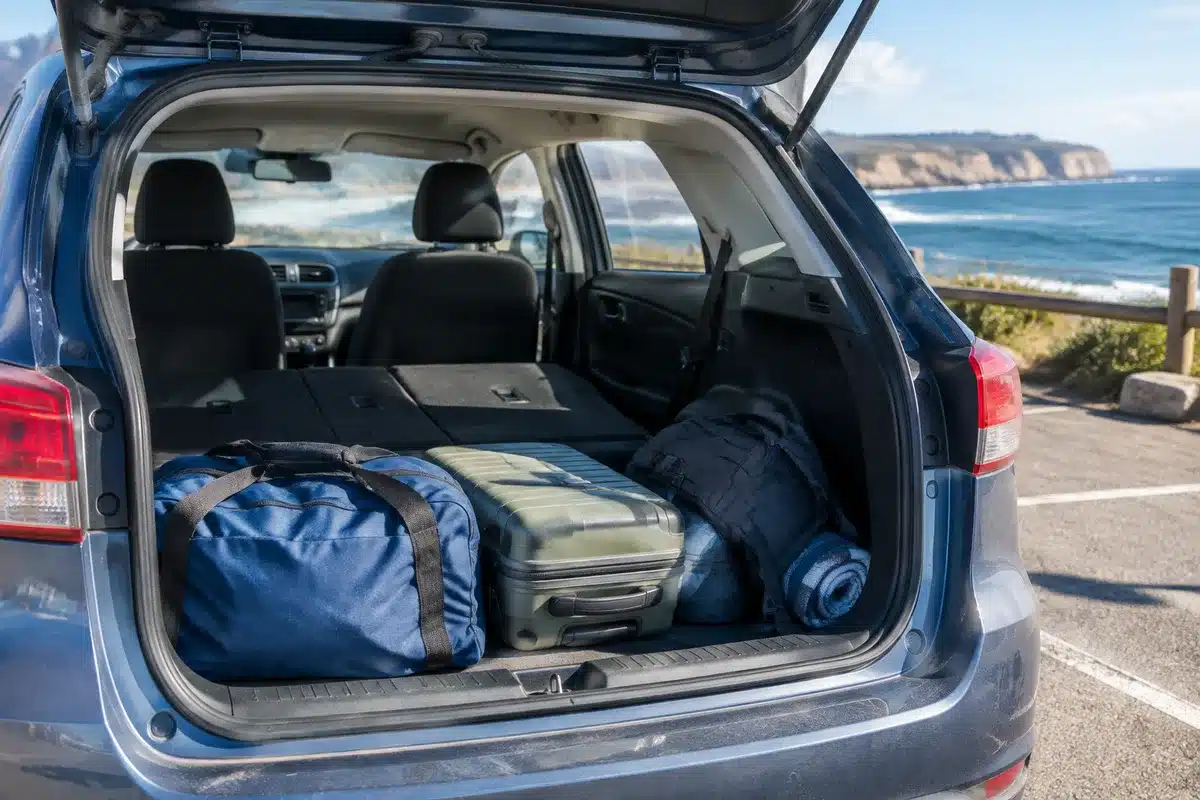
The boot is another strong point. Freed from a conventional engine, fuel tank and exhaust, the Polo offers a large luggage area — 456 litres — which is even more than some compact MPVs like the Renault Scénic E-Tech.
A two-level adjustable floor helps organise the space. There’s no front trunk (frunk), but given the cabin and boot volume, that omission is hardly glaring.
Infotainment: solid execution
If you read my ID.3 Neo review, much of this will be familiar: the Polo inherits screens and software from its larger sibling.
All Polo models get two displays: a 10.25-inch driver display and a 12.9-inch central touchscreen running ID. Software 6 (the latest generation based on Android Automotive).
Unlike manufacturers that lean on Google services directly, Volkswagen wraps its own applications around the OS — similar to Audi or Porsche. That means no native Google Maps or Gemini, but a unified interface consistent with other VW models.
That’s not necessarily a bad thing. Volkswagen has invested heavily in making its software more reliable since the early ID.3 days, and version 6 benefits from those improvements.
Menus are logical, shortcuts are customisable and Android Auto / Apple CarPlay support comes standard. In short, the system feels refined.
The instrument cluster also earns praise: it offers clear, coherent displays for speed, driver aids and navigation. For those who enjoy nostalgia, there’s even a “Retro” view that mimics classic Golf dials.
Personally I still find the information set a bit sparse at times, but the presentation and functionality are sympathetic and user-friendly.
Driver assistance: on par with larger cars
Volkswagen has also invested heavily in driver assistance systems.
Every Polo includes the safety aids required by the EU GSR-2 regulation (driver attention warning, over-speed alerts, lane departure warnings, reversing sensors, etc.). Move up to the mid trim and you get adaptive cruise control and a rear-view camera as standard.
The full suite that enables semi-autonomous level-2 driving (adaptive cruise, lane-keeping assist and semi-automatic lane changes) is available as an option, along with a 360° camera and automatic parking assist.
Our Corsican test route didn’t allow a full stress test of these systems, but stretches of dual carriageway gave us confidence: like the ID.3 Neo, the Polo’s assistance systems feel solid, comfortable and reassuring.
Driving: real command
A city car that packs a punch
Volkswagen kept the drivetrain choices straightforward: every Polo EV uses the same front-mounted motor (called APP290), with output varying by battery pack.
The smaller battery is paired with 99 kW (135 hp) and 267 Nm of torque — except for the base €25,000 trim which is detuned to 85 kW (116 hp). The larger battery, however, is matched to a surprisingly potent 155 kW motor, equivalent to 211 hp.
That’s a notable figure for a hatchback primarily intended for everyday drivers, especially as the forthcoming GTI variant peaks at just 266 hp.
Performance reflects the numbers: 0–100 km/h in 7.1 seconds and a top speed of 160 km/h. By comparison the Renault 5 with 150 hp posts about 8 seconds for the same sprint.
Very composed handling
We drove a car equipped with the larger battery, necessarily paired with the 211 hp motor — production of the small-battery units had not yet begun at the time of testing.
What stands out is how mature the ID. Polo feels on the road. Around town it’s smooth and easy to drive, and Volkswagen has finally corrected one awkward trait of earlier models by moving to an electronic brake-by-wire system that gives the pedal a more natural, reassuring feel.
The one-pedal braking mode is available in two strengths and lets you bring the car to a full stop without touching the brake pedal — both settings felt fairly strong to our taste. Despite large wheel sizes, ride comfort remains composed: firm in the Volkswagen tradition but never harsh.
There are two minor compromises: the front motor slightly increases the turning circle (10.9 m versus the ID.3’s 10.2 m and the R5’s 10.3 m), demanding more steering input in tight maneuvers; and the Polo’s width can be awkward in narrow subterranean car parks.
But overall impressions are highly positive, especially once you leave the city. On Corsica’s winding roads the ID. Polo showcased the brand’s chassis expertise. In spite of the high power and torque sent to the front axle, the car never loses composure and remains predictably balanced.
Steering is pleasant, body roll controlled, and acceleration feels strong and usable. Even if you push it hard, the front end will gradually widen its line before the ESP intervenes elegantly to correct the trajectory.
When driving at a more moderate pace, the Polo returns to a comfortable, quiet cabin for long journeys; the driver’s seat can even be upgraded with an optional massage function (€790) for added comfort.
Battery, consumption and range: class-leading figures
Two battery options
Volkswagen offers two battery capacities rather than reinventing the approach.
The smaller pack is nominally 37 kWh (36.9 kWh usable, 38.5 kWh gross) and uses LFP (lithium iron phosphate) chemistry. Volkswagen claims up to 331 km WLTP range and a consumption of 13.7 kWh/100 km when accounting for charging losses.
Notably, fast charging capability is standard across the range — a move that forces competitors such as Renault to match it. The small battery can charge from 10 to 80% in about 23 minutes at up to 88 kW. On AC, an 11 kW charger will recharge it fully in roughly 4 hours.
The larger option is a 52 kWh pack (52.6 kWh usable, 56.0 kWh gross) using NMC chemistry. That increases claimed WLTP range to 453 km with a consumption of 13.3 kWh/100 km. Fast charging 10–80% takes around 24 minutes (up to 105 kW), and a full recharge on an 11 kW wallbox takes about 5.5 hours.
Those figures put the Polo ahead of the Renault 5 on paper: the R5 lists around 310 km and 430 km WLTP for its small and large batteries, respectively, and needs about 30 minutes to go from 15 to 80% on a rapid charger. A Romanian outlet’s first comparative test has already highlighted the Polo’s technical advantages.
Consumption appears well controlled
We couldn’t conduct a long motorway run during our test, but the energy figures recorded in Corsica were encouraging.
In urban conditions—with ambient temperatures near 30°C, with the air-conditioning on and without deliberate eco-driving—we saw around 13.5 kWh/100 km on the trip computer, suggesting roughly 390 km of range in those circumstances.
Over a mixed peri-urban route that included steep climbs and regenerative descents, we averaged 13.4 kWh/100 km over 166 km, which translates to a theoretical range near 393 km.
We didn’t get to trial rapid charging ourselves, so a longer test will be needed to confirm real-life charging speeds and long-distance consumption, but the early signs are promising.
Price, competition and availability: premium features come at a price
Volkswagen is quick to point out that the ID. Polo starts at €24,990 in Trend trim (before any purchase incentives), which provides the essentials: 17-inch wheel covers, manual air conditioning, and the twin displays with Android Auto / Apple CarPlay compatibility — but little else.
Opting for higher equipment or the larger battery pushes the price up quickly. The mid-level trim costs around €29,920, while the entry price for the version with the big battery begins at about €35,820.
Some choices are irksome: heated seats can be obtained only via an extra-cost option or subscription model, and the heat pump is an expensive (€1,150) extra — reminders that Volkswagen is careful about where it places standard equipment.
However, incentives and dealer discounts change the picture. Removing the ecological bonus (rebranded as CEE support) and factoring in typical discounts (around €1,000 on the base trim, €3,000 elsewhere) brings the Polo’s effective price down: from about €20,460 for general buyers and as low as €17,850 for qualifying lower-income households. The larger-battery Polo can start from roughly €29,285 after similar adjustments.
Even so, the Polo remains more expensive than the Renault 5, and it must also face incoming small EVs from China that undercut European pricing. Models such as the MG4 Urban, Geely E2 and soon the Leapmotor B03 may not match the Polo’s overall sophistication and versatility, but well-equipped variants at aggressive prices could make potential buyers think twice.
For example, a Geely E2 with 345 km WLTP range is listed at €24,990, an MG4 Urban with 325 km starts at €19,990, and the B03 is expected to be similarly priced — all offering generous equipment levels for the money. That’s something buyers should weigh when considering the ID. Polo.
Similar Posts
- Skoda Epiq Review: Discover Volkswagen’s Most Affordable SUV Starting at €25,000!
- I Tested the MGS6 EV: Here’s Why It Falls Short on Long Journeys Compared to Tesla Model Y
- We Tested the Skoda Enyaq Electric with 600km Range: Here’s Why It Beats a Volkswagen
- We Tested the Peugeot e-5008 Dual Motor: Powerful, But Poor Battery Choice
- We Tested the Kia EV4: Could It Truly Rival the Tesla Model 3?

Maya Singh is a senior editor covering tablets and hybrid devices. Her work explores how these tools reshape digital productivity and learning. She also contributes to feature editorials on emerging tech.