
Scientists confirm: This is the most effective way to get your cat’s attention, according to new research
Elderly Couple Refuses Reserved Seats—Viral Train Standoff Sparks Fiery Debate on Courtesy
The market for high-end ultra-short throw projectors has been booming in recent years, and the Awol Vision Aetherion Max enters with a particularly bold proposition. Officially launched at CES 2026 in Las Vegas, this flagship model of the Aetherion range (which also includes the Pro version) represents the culmination of considerable thought on what a modern ultra-short throw projector should be: powerful, precise, connected, and versatile.
As a reminder, Awol Vision is a brand known for developing the Valerion range of high-end long-throw projectors.
The positioning of the Aetherion Max is clearly that of a premium product, aimed at those who want an uncompromising home cinematic experience. Its price pits it against serious and well-established competition. Notably, the Hisense PX3-Pro, which remains a very solid reference in the category, along with the Formovie Theater and the Xgimi Aura 2. It must justify its high price tag with performance that meets expectations.
Technically, it relies on a triple RGB laser architecture paired with a 0.47-inch DLP chip. It supports 3D, Dolby Vision, and IMAX Enhanced. However, the standout innovation of the Aetherion Max is undoubtedly PixelLock technology, developed exclusively by Awol Vision. This system combines optical, mechanical, and digital elements to ensure pixel consistency across the entire projection surface, even at extreme sizes. This system is designed to eliminate pixel drift and color separation, two recurring issues in ultra-short throw projectors as image size increases.
Why You Should Never Reheat These Foods in the Microwave – The Hidden Dangers Experts Warn About
I tried the top 5 guard dogs—here’s what makes these breeds the ultimate protectors
Additionally, the Aetherion Max also incorporates a 7-level motorized iris system called NoirScene II, to physically control the amount of light rather than resorting to digital dimming. The result announced is an extremely high contrast on paper, not only natively, but also in Enhanced Black Level (EBL) mode reaching 60,000:1, a particularly impressive figure for a model of this kind. Finally, to top it all off, the optics are made of high-refraction sapphire glass with a rare earth coating and a Diamond-Like Carbon treatment claiming a light transmission of 99.97%, to minimize internal reflections and preserve sharpness.
On the software side, the device runs on Google TV. It is powered by the MediaTek MT9655 processor, accompanied by 8 GB of RAM and 128 GB of internal storage, enough to run the most demanding applications without slowdown. Also note a wide connectivity relying on 3 HDMI 2.1 inputs, Wi-Fi 7, and Bluetooth 5.4.
Awol Vision Aetherion MaxTechnical Specifications
| Model | Awol Vision Aetherion Max |
|---|---|
| Type of Throw | Ultra-short throw |
| Image Resolution | 4K UHD |
| Technology | DLP |
| Brightness (ISO) | 3300 Lumens |
| HDR Compatibility | HDR10, HLG, Dolby Vision, HDR10+ |
| Number of HDMI Ports | 3 |
| ALLM | Yes |
| Operating System | Google TV |
| Product Sheet |
Testing Conditions
The Awol Vision Aetherion Max projector tested was loaned by the brand. It was tested in conjunction with a Lumene Extra Bright Eden 240C screen available at Son-Vidéo.com, a model specially designed for ultra-short throw projectors. Measurements were performed with professional equipment directly in front of the screen to minimize errors and offer values consistent with what the viewer can actually see. This protocol is identical for all ultra-short throw projector tests to allow for comparison.
Awol Vision Aetherion MaxDesign: A Bold Sci-Fi Aesthetic
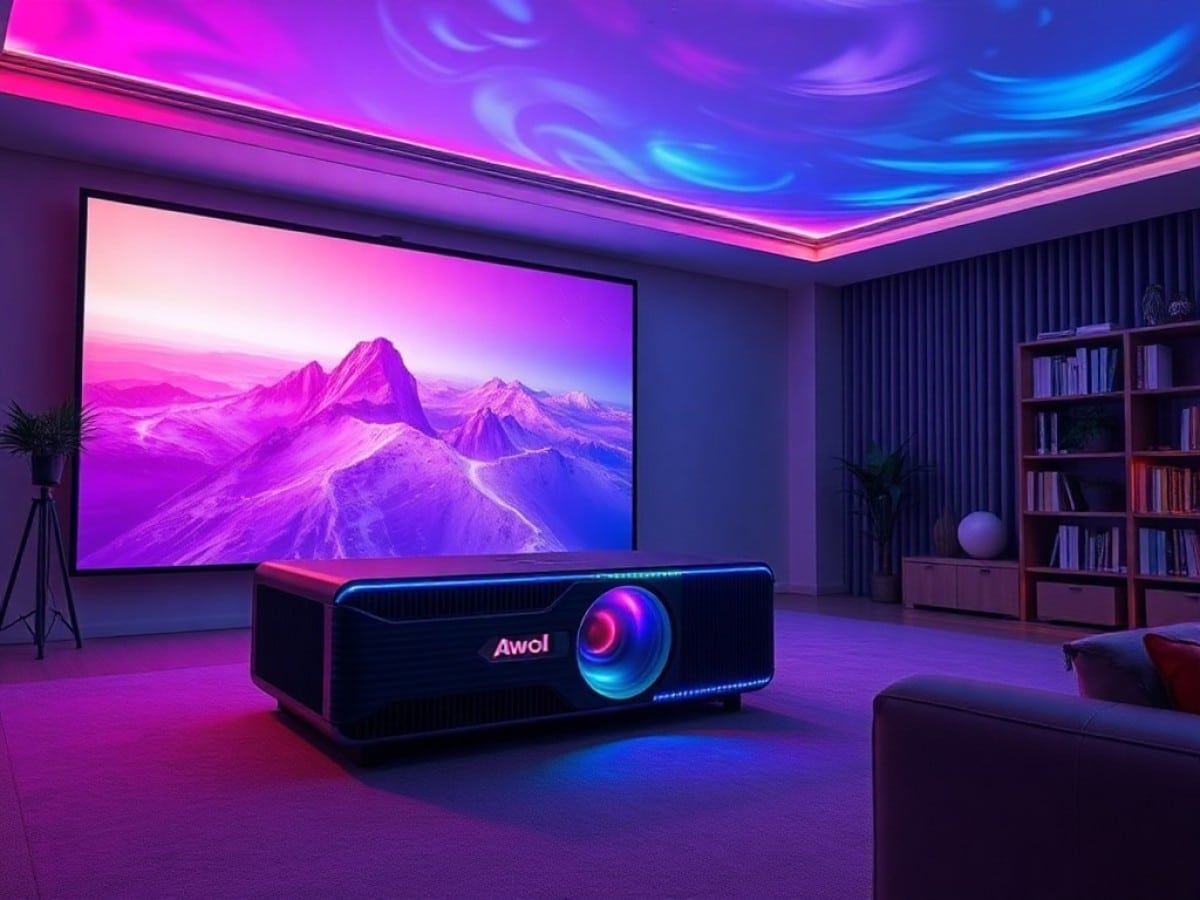
While many ultra-short throw projectors aim to be discreet or adopt a sober style to easily blend into an interior, the Awol Vision Aetherion Max clearly takes the opposite approach. Indeed, its design is deliberately spectacular, with very sharp angular lines, multi-level surfaces, and a silhouette that more closely resembles a futuristic space module than a domestic audiovisual device. The effect is striking at first glance, and it immediately becomes clear that this is a premium product that proudly asserts its status.
At the front, there is a cyan LED strip that gives it a definitively different look from other models on the market. Rest assured, if you don’t want this light beam, you can turn it off.
The chassis is imposing and massive, as evidenced by its dimensions of 56.2 cm wide, 32.3 cm deep, and 14 cm high, with a weight of 8.76 kg. This is clearly not the most compact product on the market, but these proportions are explained by the wealth of technology packed inside.
The top surface of the Aetherion Max features a high-end metal treatment intended to provide excellent durability and a sensation of robustness that can withstand anything. The finishes are impeccable, with every detail clearly having been carefully crafted.
The front facade is dominated by an impressive optical block. The brand has even added a motorized anti-dust cover that opens and closes automatically with each power-up and shutdown of the device. This may seem like a minor detail, but it shows real thought about the durability and protection of the optics over the long term, a legitimate concern for a product at this price level.
Unlike the Hisense PX3-Pro, which does not have a cover to protect its lens (and which provides just a cleaning cloth), the Aetherion Max therefore incorporates a worthy protection mechanism. This is a notable difference between the two products and a clear advantage for the Awol.
Below, 4 adjustable feet allow for very precise leveling of the device to achieve a perfectly aligned image on the screen or wall, even on a slightly uneven surface.
There are also 4 universal screw holes for ceiling mount attachment, if necessary.
The unit rests on an optimized ventilation system to evacuate the heat generated by the three laser sources while minimizing noise. The ventilation grilles are elegantly integrated into the overall design, towards the sides. There is no external power supply unit, a single power cable is sufficient to power the device, simplifying installation and reducing visible cabling. Bravo!
Awol Vision Aetherion MaxConnectivity: An Exemplary Provision
All the connections of the Awol Vision Aetherion Max are grouped at the back of the device, except for a USB port positioned on the side, which facilitates the playback of multimedia content from a removable USB drive without having to move the device or disrupt its setup.
Also note the presence of a headphone jack output on the left side of the device. Convenient.
The array of connections is particularly complete for a projector. There are three HDMI 2.1 inputs, one of which is eARC compatible to allow digital audio return to a soundbar or AVR amplifier. Unlike the Hisense PX3-Pro, whose one HDMI input is limited to 60 Hz in Ultra HD, all three HDMI ports of the Aetherion Max are fully usable for Ultra HD signals at 120 Hz, a welcome advantage for users who wish to connect multiple high-performance sources simultaneously. A DisplayPort is also present, a connection still rare on this type of device and particularly welcome for PC users who want to enjoy a large gaming or work screen. Note that the brand provides not only a very high-quality HDMI cable but also a USB-C to USB-C cable, if needed.
Audio connections are also well provided, with an optical digital audio output allowing the device to be connected to an amp or soundbar via a Toslink optical cable.
Regarding wired network connectivity, a Gigabit Ethernet port is available for those who prefer a wired connection to Wi-Fi to ensure maximum stability during streaming. The integrated Wi-Fi 7 ensures particularly high wireless speeds, far superior to the Wi-Fi 6 or 6E standards of competing devices, and Bluetooth 5.4 allows for easy connection of a soundbar, speaker, or wireless headphones.
As with many ultra-short throw projectors, the absence of a 12V Trigger port, which would allow automatic synchronization of a motorized screen with the startup of the projector, can be lamented. It’s not a dealbreaker, but it’s a gap that is also found in direct competitors like the PX3-Pro. However, note that it is possible to proceed differently, using a USB dongle, for example. There is also no integrated DTT tuner, but this remains consistent with the home cinema positioning of the device.
The Remote Control: Simple and Effective
The remote control included with the Awol Vision Aetherion Max is of an intermediate size, more compact than that of the Hisense PX3-Pro, but large enough to offer a well-thought-out number of buttons. It benefits from a partial backlighting system. Its design is clearly oriented towards ease of use, with essential functions accessible directly without having to navigate through menus.
It features direct access buttons to major streaming platforms (Netflix, YouTube, Amazon Prime, Disney+). The remote is Bluetooth, which means it’s not necessary to point it at the device to control it, a practical advantage for everyday use. It also includes a microphone for voice commands via Google Assistant, allowing you to start a search or open an app by voice. Also note the presence of a button to access artificial intelligence functions. It responds very well under the fingers and the click ensures that the command has been accepted. It is powered by two AAA batteries.
Awol Vision Aetherion MaxThe Screen
The Awol Vision Aetherion Max projector is delivered without a screen. Everyone is free to project an image that can reach 200 inches on the wall, although the rendering is better with a suitable screen.
If the budget is limited, one might also be tempted to install it without a screen (using a wall as the projection surface) and thus lose the benefit (relatively significant) of having an optimized surface for projection. Count on spending between 500 and 2,700 euros for screens of various sizes whose surface benefits from a specific treatment.
Awol Vision Aetherion MaxInstallation: Quick Setup
Like all ultra-short throw models, the first step in installing the Awol Vision Aetherion Max is to place it just a few centimeters from the wall or screen. By installing it about 15 cm away, a 100-inch diagonal image is obtained. The focal distance is thus quite short. This notably allows it to be installed on a standard TV stand while taking into account its depth.
Horizontal alignment is easily adjusted thanks to the adjustable feet. Keystone correction is automatic and digital, with very convincing results in most configurations. Note that the system offers a correction by taking a photo via a smartphone. A connection must be established between the device and the mobile, then the adjustment is carried out automatically.
On paper, this is quite convenient, but during my test, although I followed the setup advice, the procedure did not work the first time. The correction was not optimal, and I had to manually adjust the edges and corners of the image. The image can be adjusted either from the 4 corners or from 8 points for a more precise result.
Otherwise, the automatic focus works effectively, and the image is sharp across the entire projection surface, including in the corners, a point that Awol’s PixelLock technology ensures.
The entire installation process takes about ten minutes, even for an uninitiated user, which is a real positive point for this type of device.
Awol Vision Aetherion MaxImage Quality in Subjective Mode: Stunning Cinematic Quality
The Awol Vision Aetherion Max uses a DMD DLP chip coupled with a triple RGB laser light source, that is, three distinct laser sources in red, green, and blue. Unlike most UST projectors that use a blue phosphor laser, this RGB architecture achieves significantly more saturated and accurate colors, with particularly wide coverage of the REC.2020 color space (see measurement figures below).
In practice, this results in a livelier, deeper, and more natural image simultaneously, without the green color drift that can sometimes be observed with blue phosphor laser projectors.
The Ultra HD definition is simulated via the XPR (pixel shifting) system, which projects two slightly offset Full HD images at very high frequency to recreate the illusion of a native 4K image. Awol’s PixelLock technology comes into play here to ensure that this pixel alignment remains perfect across the entire projection surface, even at large image sizes. The result is remarkably sharp, uniform from the center to the four corners of the image, without chromatic aberration, edge blur, or geometric distortion.
Several image modes are available: Standard, Cinema, Filmmaker, Sport, Vivid HDR, as
Similar Posts
- Hisense PL2 Review: Top Sharpness and Contrast, But Colors Could Improve
- LG CineBeam S Review: Ultra HD Mini Projector With Winning Design Fits Inches From Wall
- JMGO O2S Ultra Review: Compact Ultra-Short Throw Packs a Bright Punch!
- I Tried the Leica Cine Compact 1: Experience Easy Living with 4K Laser Projection
- Optoma Photon Go Review: Transform Any Wall into a Giant Screen with This Mini Projector!

Maya Singh is a senior editor covering tablets and hybrid devices. Her work explores how these tools reshape digital productivity and learning. She also contributes to feature editorials on emerging tech.