
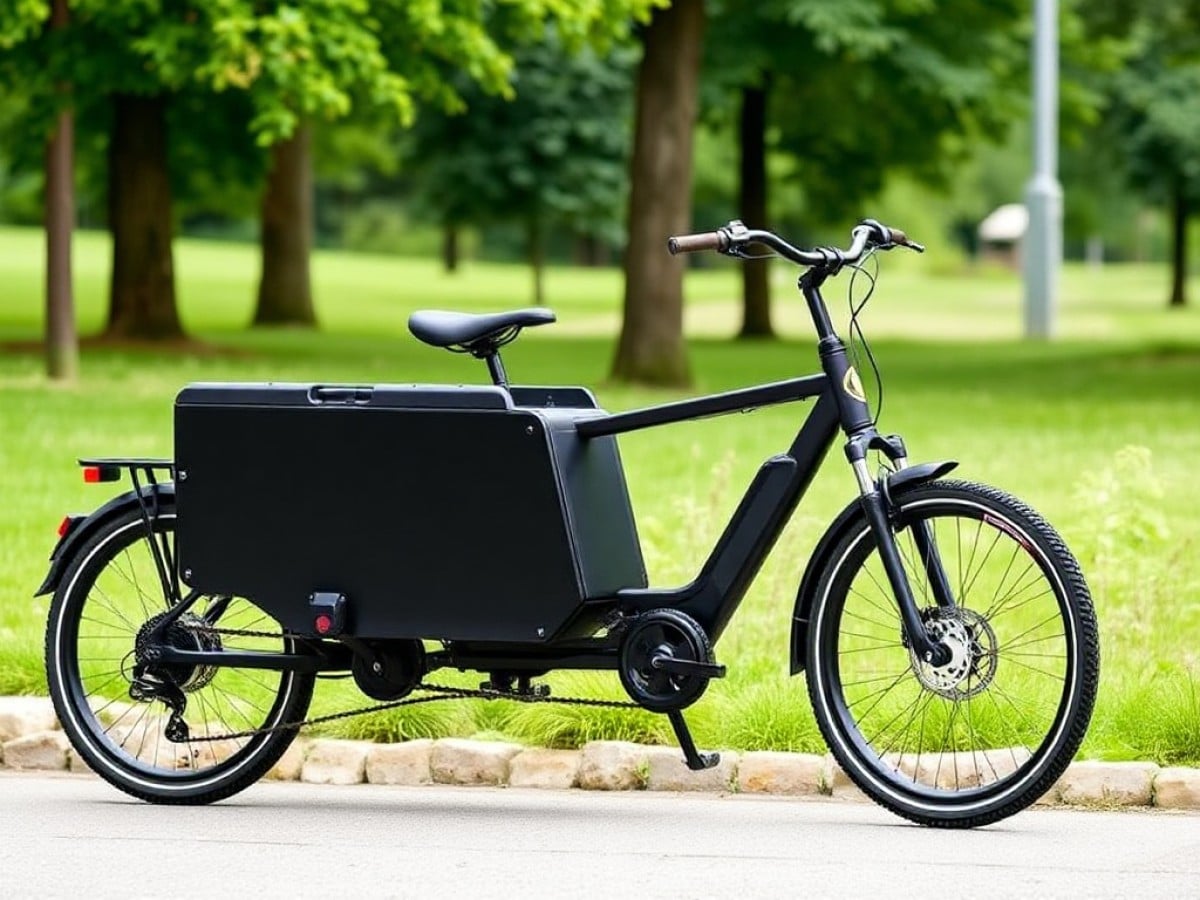
Despite its compact size, the Shwette Baggy electric cargo bike offers an intriguing option in the cargo bike category, equipped with delightful Virvolt assistance. We’ve put it through its paces, and here’s our detailed review.
Scientists confirm: This is the most effective way to get your cat’s attention, according to new research
Elderly Couple Refuses Reserved Seats—Viral Train Standoff Sparks Fiery Debate on Courtesy
Introduction
Electric cargo bikes are increasingly popular among French families, accounting for over 10% of electric bike sales. Unlike our European neighbors, the French have a particular fondness for longtail bikes. Cargo bikes are often seen as work tools or too cumbersome for our densely packed city centers.
The solution might lie in smaller cargo bikes. This segment is still finding its feet with various formats, such as the Muli (16-inch front, 20-inch back) or the Riese & Müller Carrie 2 (20-inch). The brand Shwette has entered the scene with a 20-inch front and 24-inch rear proposition.
Founded by Jean-Marc Seynhaeven, this startup aims to make a statement with its compact model named Baggy. Entrusting the assistance to Virvolt and equipped with a large battery, this electric cargo bike features a foldable front basket capable of carrying a passenger, a child, or a dog. After an initial quick test last year, we’ve now thoroughly tested this unique electric bike. Here is our comprehensive assessment.
Technical Specifications
| Model | Shwette Baggy |
|---|---|
| Dimensions | 205 cm x 68 cm |
| Motor Power | 250 watts |
| Number of Assist Modes | 3 |
| Claimed Range | 80 km |
| Removable Battery | Yes |
| Bluetooth | No |
| GPS | No |
| Display | Yes |
| Weight | 38 kg |
| Color | Green, Cream |
| Maximum Load Capacity | 190 kg |
| Headlights | Yes |
| Taillight | Yes |
| Fiche produit |
This review was conducted using a model provided by the brand.
An Unconventional Cargo Bike Format
To start with, the Shwette Baggy needs to be defined and measured. Its length is 2.02 meters, whereas a more conventional cargo bike typically measures around 2.50 meters. This is slightly more than a Muli (1.98 m) or the folding Car.los V1 (2.01 m), but less than the compact segment leaders Urban Arrow Shorty (2.03 m) and R&M Carrie 2 (2.09 m).
Compact as it may be, this cargo bike is still larger than a standard electric bike. However, it boasts two additional features: a folding basket and a rotating stem. From its usual 60 cm, the Baggy can reduce its footprint to about 18 cm. The pedals are fixed – future folding models are not out of the question – leaving the net width at 40 cm.
Shwette aims to enhance the handling of its bike, but the central kickstand requires a bit of strength to position and remove. The bike is also quite heavy, weighing in at 38.3 kg. A handle under the saddle allows for lifting the rear if necessary (over a high step, through a narrow space), but only by a few centimeters. In terms of design, the Shwette opts for a steel frame, here in matte white paint, with external cabling.
This may not be the most aesthetic choice – though the bike retains an attractive format – nor the easiest to clean, but the idea is to ease repairability. The lighting, linked to the battery, could also be upgraded, especially with a broader and more powerful front beam.
Loaded with Features
Compact yet practical, the Shwette Baggy is a true electric cargo bike. In total, including the bike itself, it boasts a total permissible weight of 190 kg. It features two loading areas: a front basket supporting 30 kg and a rear rack supporting 60 kg.
We tested several configurations in the front basket, with a 120-liter capacity: basket with a cat, plants, groceries, etc. It can be folded in two positions: semi-closed with a small storage volume if you want to ride with less width in traffic, or park and store your helmet, for example, or completely closed.
A minor issue, the magnets closing the two side parts lack power. While they hold in semi-closed position, fully closed requires a cord or a bungee. Promised, this will be fixed in a future version, while the brand provides a small free Hiplock-type padlock.
The rear rack is conventional, used for a child’s bike seat, a large parcel, or to transform it into a two-seater. On our test model, we had the passenger version with its cushion and foldable footrests. Otherwise, the equipment includes lighting (adjustable at the front, but no rear stop light), as well as mudguards. We would like these to be a bit longer to provide better protection from splashes.
The bell is also among the equipment to improve, but it remains too cheap in our view since it broke after only a few kilometers. Finally, the Baggy adds a central pocket, between the steering column and the seat tube. The small pouch allows storing the charger, a water bottle, and a few small items. Very handy!
A Display Without Connectivity
The Shwette Baggy features a central display, provided with the Virvolt assistance solution. This color display is quite flattering at first glance, and well-lit at night. It shows speed with decimals, time, current mileage, and two gauges.
The first gauge on the left in an L shape indicates the motor’s power, while the second on the right in a J shape shows energy recovery (more on this below). Two small side buttons are used to change the assistance mode or activate the lighting.
The bike indeed has an odometer, last trip mileage, average speed, and real-time battery voltage.
The five-bar gauge is a bit limited for accurately tracking remaining autonomy, in addition to not being 100% reliable.
The brand also indicates that an anti-theft motor lock when stopped will be made possible via a firmware update. And in the long term, since the display is Bluetooth-ready, connection with a future application will also be possible.
Stable Riding for This Compact Cargo Bike
As a cargo bike, the steering is not direct, passing through a wired system. Thus, a little adaptation is required, but this happens very quickly. The Shwette Baggy handles easily, especially with excellent stability allowed by the rigid frame and wide Schwalbe tires. It’s hard to say it’s ultra agile, particularly with pronounced understeering, but we never felt heaviness on the handlebars.
This is even the case with a rear passenger at the limit of the permissible weight. No imbalance felt, the compact cargo bike holds the road well, but comfort is not its strong suit. The passenger suffers from every imperfection or speed bump where you have to ride slowly. A mini handlebar could relieve them, in place of the handle under the saddle.
If you are alone on the bike, the comfort is decent, knowing that the steel of the frame is more flexible than the aluminum predominantly used by competitors. The quite upright riding position, adjustable with the stem or seat post, helps relieve the back on very long journeys. Still, the seating is a bit soft, a suspended post option would be welcome. However, the braking is ultra-effective… and double.
Regenerative Braking
A feature shared with the Vefaa Bonjour Techno and the Anod Hybrid 2, the electric bike has regenerative braking signed eBikeLabs directly in the motor. Just backpedal a quarter turn to slow down significantly. This has little effect at 25 km/h, but by anticipating before a red light or an intersection, you don’t touch the brakes 90% of the time.
In case of necessity, the hydraulic disc brakes Shimano MT200 (180 mm discs) immobilize the Baggy in 2.30 m at 25 km/h, very safe in the city! However, avoid this with a passenger, at the risk of having their dental imprints in your lower back.
A Very Powerful Motor
To propel the Shwette, it’s the French Virvolt 2000 motor that operates in the rear wheel. Although it is not a central motor like with competitors, the 70 Nm torque is robust. This is the case from the start with a torque sensor on the lookout, whose desire to release the watts is felt from the slightest push on the pedals, especially in Boost mode.
There’s no absolute need to shift down the Shimano derailleur gears, as the eBikeLabs system operates to adapt the response of the assistance according to the cyclist’s demand. You might find yourself starting sometimes in 8th gear without any trouble, but it’s still preferable to downshift to preserve the chain over time.
On a steep climb, it maintains 25 km/h without faltering. The motor’s vigor also adds stability from the first km/h when you’re transporting a passenger with you.
Also, you can always engage the pedestrian mode, then switch to the second Standard mode, less nervous on flat ground. The motor is, however, noisy: it’s not bothersome in dense traffic, but less pleasant on a quiet ride for two.
Large Autonomy, Unreliable Gauge
We mentioned earlier that the wiring wasn’t integrated, and neither is the battery. It is housed vertically behind the steering column, partially protected by a small pouch (better in case of rain). Large in volume and weight (3.73 kg), the battery has a capacity of 730 Wh (20 Ah).
This large amount of energy allows covering about 80 km in the maximum Boost mode. We rode on terrain with slight slopes in the Paris region, in mild conditions (15°C) with an 80 kg load. Given the characteristics and weight, the bike’s motor consumption is reasonable, around 9 Wh/100 km. It’s hard to estimate in Standard mode, where we estimate exceeding 100 km of autonomy.
The display does not indicate precise charge with its 5 bars, which are also very imprecise. The first bar disappears after 25-30 km, the second after 15 km, then everything accelerates very quickly. The gauge also fluctuates whether you are riding or not. You even find yourself going from 4 bars at a stop to 2 bars a few meters further, due to the lack of a controller communicating perfectly with the battery. It thus takes a long adaptation time to know the remaining autonomy.
Slow Charging in 9 Hours
Charging can be done on the bike or by removing the battery. This manipulation is difficult, as is putting the battery back, taking 4 or 5 attempts. The supplied charger with a power of 126 W (3A) restores full energy in just over 9 hours.
The charging tracking is as imprecise as the discharge, as you regain two bars in less than an hour, the third appears after more than 3 hours, and the fifth (over 80%) after 7 hours. If charging on the battery, a 4-light gauge helps track the progress.
An Electric Cargo Bike Cheaper Than the Competition
For now, it’s a unique model, the first from the French brand. The Shwette Baggy is also available in only one version at a base price of 3,890 euros. However, the catalog includes several customization options, starting with the frame color (shiny olive green or matte cream), or the color of the basket (black or green) even with patterns (+40 euros).
Regarding accessories, the electric cargo bike offers 5 paid options:
- Central pocket: 100 euros
- Rear seat with footrests: 100 euros
- Rear cushion for dogs: 70 euros
- Front baby seat: 280 euros
- Waterproof cover for the basket: 40 euros
Our test model came to 4,170 euros, with a rear seat, a patterned basket, a basket cover, and a central pocket. Certainly more refined and compact, the Muli Motor ST is much more expensive (starting at 5,380 euros). The other serious competitor, Urban Arrow Shorty, starts at 4,999 euros with its 150-liter front space, Bosch motor but without a rear rack, nor the possibility of a two-seater.
90% European Manufacturing
Another ethical advantage, the Baggy is mostly manufactured in Europe (frame, fork, rear rack, and assembly in Portugal) or even French for the motor, battery, and wheels. We are here at 90% value from France. The remaining components such as the basket come from Tunisia (not so far away) and the transmission-brakes duo from Asia.
Shwette allows you to try the electric bike at more than a dozen dealers in France, where after-sales service is offered. The frame, fork, and rear rack are guaranteed for 4 years, the rest for 2 years excluding wear parts. Conveniently, the official website helps with the maintenance of the electric bike thanks to a comprehensive FAQ.
Shwette Baggy
at the best price
There are no offers at the moment, discover
-
Moustache Lundi 27.3
3,499 €
8/10
Read the review -
Decathlon Longtail R500Elec
2,999 €
9/10
Read the review -
Decathlon Rockrider E-ACTV 900
2,699 €
9/10
Read the review
Similar Posts
- Nakamura Crosscity+ Review: Best Electric Cargo Bike for Kids on the Market?
- Tested: Ritmic Duo Electric Car – Perfect City Companion with Massive Range!
- Tested: The 2025 Tern GSD S10 Electric Cargo Bike – A Pricey Dream Ride!
- I Tried the Yuba Boda Boda: Discover the Joy of Riding This Electric Cargo Bike!
- We Tried Moustache’s New Family Electric Bike: Could This Be the Perfect Ride?

Maya Singh is a senior editor covering tablets and hybrid devices. Her work explores how these tools reshape digital productivity and learning. She also contributes to feature editorials on emerging tech.