

Scientists confirm: This is the most effective way to get your cat’s attention, according to new research
Elderly Couple Refuses Reserved Seats—Viral Train Standoff Sparks Fiery Debate on Courtesy
Panasonic is actively expanding its full-frame mirrorless line. The Lumix S1 II and Lumix S5 II are notable for their top-notch video features: 6K, Open Gate, internal RAW, LUT support, all priced competitively to shake up the competition. The brand continues its work with Micro Four Thirds (Micro 4/3), although the MFT segment has clearly slowed down. The last lens release was in September 2023 with the update of the Leica DG Vario-Elmar 100-400mm f/4-6.3 II. Since then, there have been no new optics. The Lumix GH7 in 2024 was the only real novelty, with the Lumix G97 being just a minor update.
Then there’s the bridge camera range. Small, discreet, almost confidential. While many competitors have abandoned this niche, Panasonic and Nikon remain among the few brands still interested in it. The arrival of this Lumix FZ82D is almost anachronistic, as the original FZ82 was released in 2017. Smartphones have decimated the compact camera market, and bridge cameras were expected to follow. Yet, there still is a demand.
A bridge camera is a fixed-lens device with an ultra-versatile zoom. A broad focal range allows switching from a wide-angle to an extreme telephoto lens. On the FZ82D, we’re talking about a 20 to 1200 mm full-frame equivalent. That’s a 60x zoom. Impressive on paper. Something unachievable with a smartphone, even the latest models with their digital zooms and artificial intelligence.
The price is very attractive: 479 euros. Cheaper than an entry-level mirrorless camera body. Much cheaper than any comparable detachable zoom lens, which, in fact, simply does not exist. To put things into perspective: a Tamron 18-300 mm f/3.5-6.3 Di III-A VC VXD covers up to a 450 mm equivalent (compared to 1200 mm for the FZ82D) and costs about 650 euros.
But obviously, it’s not perfect. Far from it. There are significant compromises. Firstly, the sensor, which is tiny at 1/2.3 inches, even if its 18 MP isn’t ridiculous on paper. Next, the optics, which perform miracles to fit into a compact format, but show technical limitations at long focal lengths. Let’s delve into the details.
Panasonic Lumix DC-FZ82DTechnical Specifications
| Model | Panasonic Lumix DC-FZ82D |
|---|---|
| Type of device | Bridge |
| Sensor format | 1/2.3″ |
| Sensor resolution | 18.9 Mpx |
| Image stabilizer | Hybrid |
| Video recording definition | 4K@30 FPS |
| AF-S | 10 FPS |
| Articulated screen | No |
| Weight | 596 g |
| Product sheet |
This review was conducted with a device loaned by Panasonic.
Panasonic Lumix DC-FZ82DFits in a (large) pocket
The FZ82D is all plastic, except for the lens elements, of course. Panasonic didn’t try to create an illusion of luxury. But surprisingly, this budget construction doesn’t feel cheap in hand. The device remains relatively compact given the power of its zoom. It’s far from a pocket-sized compact, but it’s also not a brick.
The grip is pronounced and textured. You can comfortably wrap three fingers around it. The index finger naturally rests on the trigger, which is angled forward at an ergonomic angle above the grip. It can be held well with one hand, though, at 640 g (including battery and card), it’s better to use both hands when zooming in significantly to avoid shaking.
The zoom is electric, controlled by a ring surrounding the trigger. In practice, the motorized zoom deploys quickly. It covers the entire focal range from 20 to 1200 mm in less than 5 seconds. A slight slowdown is felt before reaching the longest focal length. Overall, it’s very responsive.
The device remains well-balanced, even when the zoom is fully extended. When the lens is retracted at rest, the device measures 130.2 × 94.3 × 125.2 mm. Fully extended, the total length reaches about 24 cm.
There’s no weather-sealing or dust protection. You’ll need to be cautious in challenging conditions. This is understandable given the price, but it’s a real limit for those who want to do wildlife photography in actual conditions.
The design recalls entry-level DSLRs from the past. Rounded corners, a prominent viewfinder bump on top. It’s somewhat the signature of modern bridge cameras.
The mode dial is well-sized on the top, surrounded by the power switch which is operated by the thumb. The device wakes up instantly. Next to it, two function buttons Fn1 and Fn2 by default access the 4K Photo and Post Focus modes. There are eight total function buttons, all reprogrammable.
The ports are located on the right side under a flap. Micro HDMI and USB-C combined for transfer and charging, that’s it. No external mic port, so you’ll have to make do with the built-in one. The battery and SD card compartment is under the device.
Surprisingly, there’s no Wi-Fi on the FZ82D, so it’s impossible to transfer the photos taken to a smartphone. A pity.
Panasonic Lumix DC-FZ82DScreen and Viewfinder
The 3-inch screen displays 1.8 million dots. This is a noticeable improvement over the original FZ82, which topped out at 1 MP. In practice, the difference is visible. The screen is sharper, brighter. It remains readable in full sunlight, although sometimes you have to shade it with your hand to see details clearly. The size is adequate for framing, but could have been more generous.
The screen is fixed. This is one of the major disappointments of this device. In 2026, even entry-level compacts have articulated screens, or at least, tiltable ones. Not the FZ82D. It’s impossible to shoot from high or low angles without bending over or kneeling. For video, it’s very limiting. For selfies, forget it.
The electronic viewfinder is OLED and offers a resolution of 2.3 MP with a magnification of 0.74x. Again, this is better than the 2017 model, which peaked at 1.1 MP and 0.46x magnification. The image is clear, shooting information is readable, and there’s a diopter adjustment for myopia.
An ergonomic detail: there’s no proximity sensor to automatically switch between the screen and the viewfinder. You have to press the LVF button next to the viewfinder. Every time. It’s annoying when you often switch between the two.
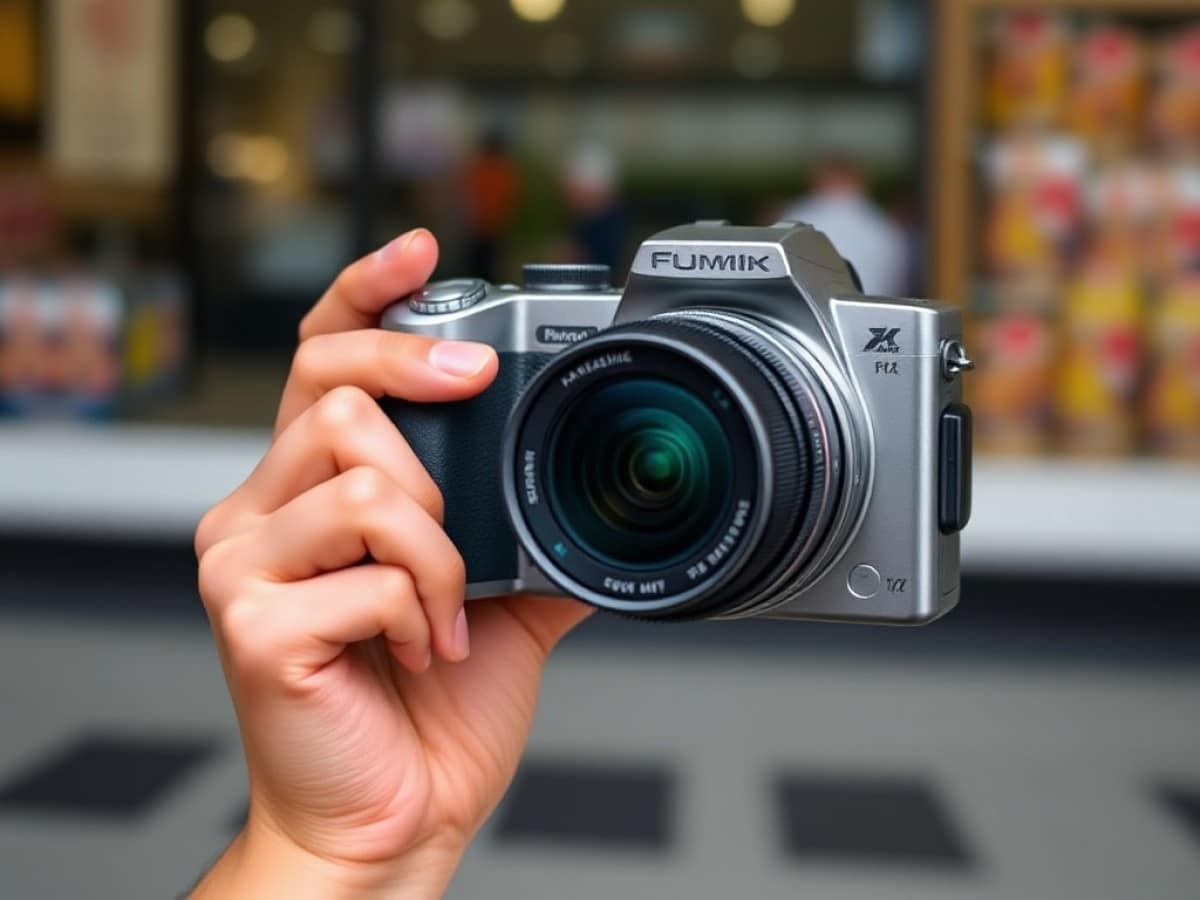
Embrace the vertical format and unleash your creativity with the Fujifilm X half. Ultra-compact and featuring Fujifilm’s legendary color rendering, it redefines photography. Take advantage of the offer for any purchase before February 28.
An interesting feature: the screen remains active even when turned off when composing with the viewfinder. You can use the Touch Pad AF function to move the focus area by touching the screen while keeping an eye in the viewfinder. It’s convenient, but be careful of nose contact which can unintentionally activate the touch function and move the AF point.
The menus are clear and well-organized. Panasonic has done a good job on the interface to avoid overwhelming the user.
Panasonic Lumix DC-FZ82DOptics
The 60x zoom is thus the main selling point of this camera. It’s a Lumix DC Vario with a real focal length of 3.58 to 215 mm. In full-frame equivalent, this gives 20-1200 mm. The construction includes 14 elements in 12 groups. There are 6 aspherical lenses and 3 ED (Extra-Low Dispersion) lenses to limit chromatic aberrations. On paper, it’s serious stuff.
The aperture varies from f/2.8 at 20 mm to f/5.9 at 1200 mm. The filter diameter is 55 mm, very modest for such a zoom. This range of aperture reveals the first major compromise. The compactness of the zoom implies low light performance, especially at long focal lengths. f/2.8 at 20 mm is okay for wide-angle. But f/5.9 at 1200 mm is frankly dark.
What does that mean in practice? In medium or low light conditions, the camera struggles to maintain a high shutter speed at long focal lengths. At 1200 mm with f/5.9, on a cloudy day, you easily find yourself at 1/125 s or even less. Result: blurry photos if the subject moves, even slightly. Or if you move. Because yes, at 1200 mm, the slightest shake is noticeable.
The solution? Increase ISO sensitivity. But then noise quickly becomes troublesome. We’ll get back to that. The other solution is to take multiple shots. Shoot in burst mode and hope one out of three is sharp. That’s the technique I adopted during my tests. Frustrating, but necessary.
Let’s talk about stabilization. The lens incorporates an OIS (Optical Image Stabilization) system of the Power O.I.S. type. Panasonic does not communicate the number of stops gained. In practice, the stabilization is effective up to about 300 mm equivalent. You can hold speeds around 1/60 s without too much blur. That’s already not bad.
But beyond 300 mm, things get complicated. Stabilization continues to work, but it no longer performs miracles. At 600 mm, you really need to stay stable. At 1200 mm, it’s downright acrobatic. The slightest micro-movement abruptly moves the framing in the viewfinder. You easily lose the subject, especially if it’s moving. A bird in flight at 1200 mm? Forget it, unless you have hands of stone.
The optics are very sensitive to flare when facing the sun. Very sensitive indeed. Point the camera toward the sun or an intense light source, and you’ll get unwanted reflections in the image. Chromatic aberrations appear quickly in these conditions. Purple or green fringes on high-contrast edges.
But the most annoying issue is the massive drop in contrast beyond 300 mm equivalent. The images become flat, dull. Fine details blur into a general mush. At 1200 mm, in cloudy weather, it’s catastrophic. As a result, the autofocus often struggles at long focal lengths when the subject is low-contrast. It eventually locks on, but it takes time. Too much time for wildlife photography.
The minimum focus distance drops to 1 cm in macro mode at 20 mm. That’s impressive. You can photograph insects, flowers, tiny details. The results are surprisingly good in this range.
Categories
Latest Articles