
Scientists confirm: This is the most effective way to get your cat’s attention, according to new research
Elderly Couple Refuses Reserved Seats—Viral Train Standoff Sparks Fiery Debate on Courtesy
The robot vacuum cleaner market is constantly innovating, and the 3i S10 Ultra introduces a real novelty.
This vacuum cleaner, marketed by a brand not yet well-known in France, features the world’s first integrated water recycling system.
In practical terms, it draws moisture from the surrounding air to automatically fill its clean water tank, then distills and purifies the dirty water for reuse. 3i promises you’ll never have to empty the dirty water or refill the clean water tank again.
Priced at 1,899 euros (though often on sale for 1,399 euros), the 3i S10 Ultra is positioned in the high-end market, alongside the likes of Roborock Saros, DJI Romo P, or Dreame X50 Ultra.
3i S10 UltraTechnical Specifications
| Features | 3i S10 Ultra |
| Suction Power | 13,000 Pa |
| Type of Washing | Rotating Mop |
| Roller Speed | 330 rpm |
| Washing Pressure | 7 N |
| Navigation | LiDAR dToF + camera + 3D structured light |
| Battery Capacity | 5,200 mAh |
| Claimed Battery Life | 180 minutes (economy mode) |
| Robot Height | 11.2 cm |
| Mop Lifting Height | 8 mm |
| Mop Extension | Automatic (UltraReach technology) |
| Clean Water Tank | Auto fill by dehumidification |
| Recycling System | Sub-boiling distillation |
| Dust Bag | 2.5 L (60 days of autonomy announced) |
| Water Production | 300 ml/h |
| Minimum Humidity | 30 % |
| Compatibility | Alexa, Google Assistant |
| Weight of Station | 22.7 kg |
| Dimensions of Station | 60 cm (height), 47 cm (width), 46 cm (depth) |
The test unit was provided by 3i.
Why You Should Never Reheat These Foods in the Microwave – The Hidden Dangers Experts Warn About
I tried the top 5 guard dogs—here’s what makes these breeds the ultimate protectors
3i S10 UltraSetup
The experience starts from the moment of unboxing, and the first impression of the 3i S10 Ultra leaves no doubt about its ambition: the box is simply the largest we have ever received for a robot vacuum.
Once opened, we find the base station, the robot itself, two side brushes, a mopping roller, a main brush, and a bottle of proprietary cleaning solution. The whole setup appears massive, and for good reason: the station alone weighs 22.7 kg, a record for this category of products.
Before first use, you need to prepare the station by installing the active carbon filter in the clean water tank at the front, then fill this tank to about halfway. This manual step is only necessary for the initial setup: afterwards, the dehumidification and recycling system takes over. It is also necessary to install the 2.5-liter dust bag in the compartment provided under the water tank. Be sure to remove all protective stickers before starting it up, there are many.
Choosing a location for the station isn’t simple. With its imposing dimensions (46 cm in height) and especially its weight of nearly 23 kg, you won’t be moving it often once installed. A dedicated space is needed, ideally in a utility room or a corner of the living room, with enough clearance on the sides for the robot to easily enter and exit. Absolutely avoid placing it in a bedroom: as with any dehumidifier, it emits a continuous hum when the water recovery system is active.
Wi-Fi connection is done via the app in a few minutes. The robot supports 2.4 GHz and 5 GHz networks, ensuring good stability. Once connected, the S10 Ultra automatically performs its first mapping of your home during the initial cleaning cycle.
The robot uses its fixed LiDAR mounted on the top (which does not rotate 360° like some competitors) combined with a front camera and 3D structured light sensors to scan the environment. The first map appears quickly in the app, allowing you to name the rooms and set no-go zones if necessary.
An important point about the water recycling system: its effectiveness directly depends on the humidity levels and temperature of your home. The app displays the ambient humidity level and allows you to schedule dehumidification times.
In our tests conducted in Nantes during the winter period, with humidity levels around 30-35%, water production was minimal. However, during tests in a more humid area (bathroom), the tank did indeed fill up by several centimeters.
3i S10 UltraErgonomics and Design
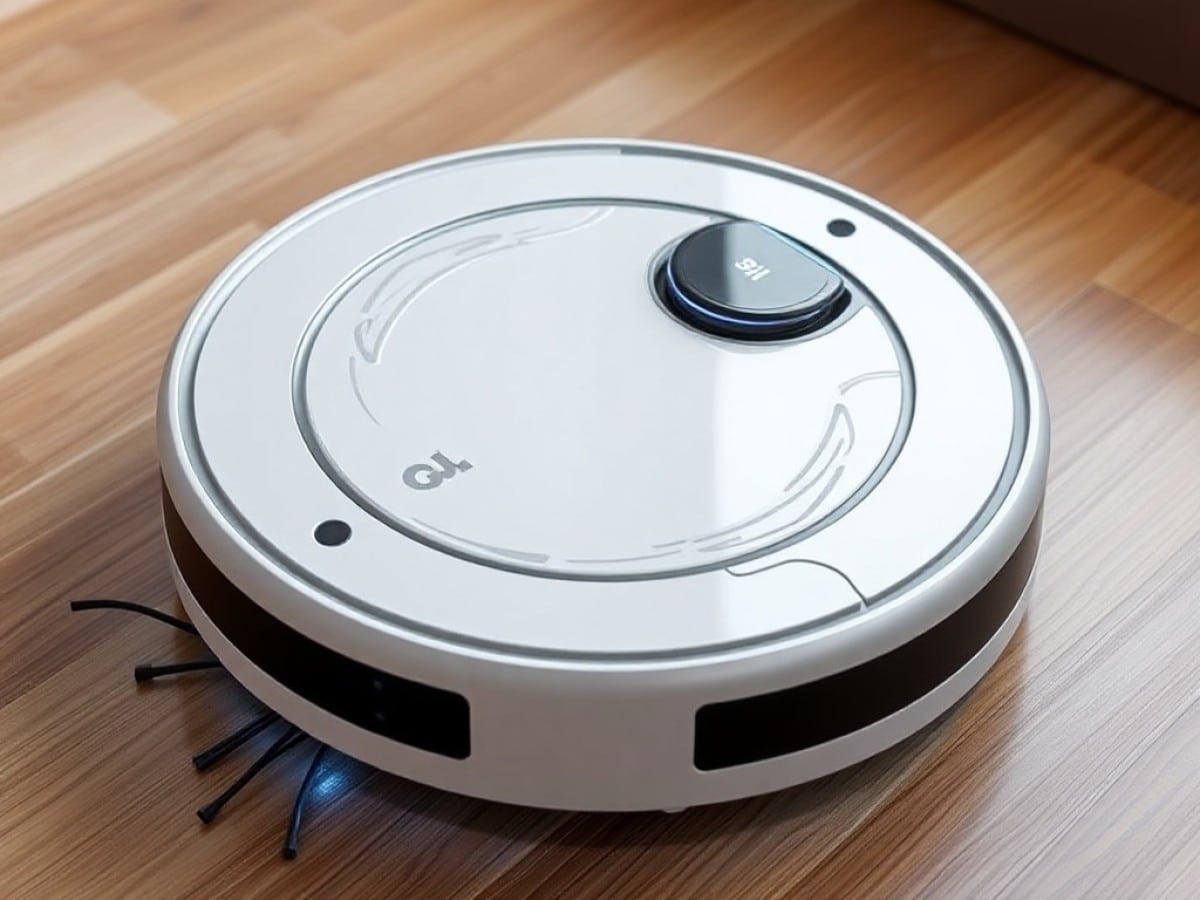
The 3i S10 Ultra has a classic circular shape with a diameter of 36 cm, but it stands out with its height of 11.2 cm, making it one of the thickest robots on the market.
This thickness is due to the integration of the fixed LiDAR on the top, but unlike other models that use this type of sensor to reduce their profile, the S10 Ultra remains bulky.
It will not fit under all furniture, especially low sofas or certain standing bookshelves. It’s a trade-off to accommodate all the onboard technology, but it’s something to be aware of before purchasing. For example, the DJI Romo P positions its LiDAR on the underside of the robot.
The overall finish is neat without being exceptional. The robot is available in only one color (white/grey), with a matte plastic that resists fingerprints well. On the top, three physical buttons allow for basic control: start/pause, return to base, and spot cleaning. A nice touch, even though most of the control is done via the app. The top cover lifts to access the internal dust bin (0.35 L) and filter, although you’ll almost never need to do this thanks to the automatic emptying.
Underneath the robot is where things get interesting. Instead of traditional flat mops or dual rotating pads, the 3i S10 Ultra uses a rotating mop roller, a solution that has become the most effective for washing in recent years. This roller spans the width of the robot and rotates at 330 rpm, a high speed that allows it to scrub the floor vigorously. Twelve micro-diffusers spread along its length continuously moisten it, while an integrated squeegee discharges the dirty water. This real-time self-cleaning system prevents dirt from being pushed from one area to another.
Its strength lies in the UltraReach function: the roller is telescopic and automatically extends when the robot runs along a wall or baseboard. We observed this mechanism in action, and it’s impressive to see the roller extend a few centimeters to clean right up to the wall, where circular robots usually leave a strip of dirt.
According to 3i, this extension improves coverage by 95% along walls. In our tests, the baseboards were indeed cleaner than with other robots, although 90° corners remain difficult to reach perfectly.
The brushing system consists of a central anti-tangle main brush and two large front side brushes. These are particularly voluminous, extending well beyond the body of the robot, which allows them to effectively sweep debris towards the center for suction.
Connected security, night vision, and local storage included. Protect your home with this kit of 2 SoloCam E42 at an unprecedented price!
Their multi-comb design is useful for preventing hair tangling, a goal achieved in our tests. But after several cycles involving many hairs and fur, it’s the main brush that ends up with quite a few hairs. The double internal comb anti-tangle system was not very effective.
At the front, there’s the camera and the green lighting system named Dirt Scan. This special green light illuminates the floor to reveal types of dirt invisible to the naked eye: spilled liquids, stains, crumbs, dust. Each type of debris reflects a distinct light signature that the camera analyzes in real time. The robot can thus recognize up to 68 types of dirt or objects and adjust its behavior accordingly. This is one of the most advanced features of this model, and it really works: we saw it slow down and change mode when it detected a liquid.
The sensors are plentiful: besides the LiDAR and camera, the S10 Ultra incorporates Time-of-Flight sensors, 3D structured light sensors on the front for obstacle avoidance, anti-fall sensors under the chassis, and ultrasonic sensors that detect the nature of the floor.
These allow it to detect a carpet from a hard floor and automatically lift its mop by 8 mm to avoid wetting the carpet. This function proved reliable in our tests: the roller indeed lifts when the robot moves from tile to carpet, allowing a complete cleaning of the house in one go.
The base station is massive. Its 46 cm height and 23 kg weight probably make it the most imposing on the market. At the front, a large panel provides access to the clean water tank (where the level is visible through a transparent window), the compartment for the bottle of cleaning solution, and the 2.5-liter dust bag. On top, it’s impossible not to notice the huge ventilation grille of the dehumidifier.
At the back, an XXL active carbon filter completes the air purification system. This station is a veritable mini-factory that handles suction, washing, drying, distillation, and dehumidification.
So yes, it’s not pretty… it’s a technical tool, not a decorative item.
3i S10 UltraPerformance
Let’s start with the S10 Ultra’s flagship system: its water recycling. In our pre-winter test conditions in Nantes, the dehumidifier produced only a minimal amount of water, a few millimeters in the tank after a full night. It’s too cold in my house.
However, with a humidity level >60% and a temperature above 19 degrees, the tank will fill up.
The function does exist and works, but its effectiveness depends on your environment. If you live in a humid region, it’s a real plus. In a dry climate or at high altitude, it will be more anecdotal. In Nantes, it depends on the weather, the house… and obviously the season.
The system for distilling dirty water worked well. After marking the initial water level in the tank, we deliberately created dirty situations: spilled coffee, dirt mixed with water… The robot cleaned all that up, and six hours later, the water in the tank was “clean,” odorless, and with a pH identical to that measured before cleaning.
We repeated the experience for several weeks without ever changing the water: it remained clean and odorless, proof that distillation works. The solid residues indeed end up in the dust bag as announced.
For normal daily use, this isn’t a problem: the robot cleans once a day, the station distills in the background, and everything is ready for the next day. But if you want to do several close passes, patience will be necessary. Or else, you’ll have to manually add water (which I did).
The other downside: the noise from the dehumidifier and the distillation system. It’s not deafening, but it’s a continuous hum comparable to a refrigerator or a typical dehumidifier, hence our advice to avoid the bedroom. Personally, I put it in the living room and only activated this system at night.
In terms of pure suction, the 3i S10 Ultra displays solid performance. With its 13,000 Pa of suction power, it ranks in the upper middle of the segment (the Dreame X50 Ultra goes up to 20,000 Pa, the Roborock Saros 10 to 22,000 Pa, the DJI Romo P to 25,000 Pa), but this number isn’t everything.
The two huge side brushes do a good job of bringing debris to the center, and above all, they never get tangled despite many hairs and fur in our test course. This is not the case for the main brush, however.
The obstacle avoidance system works well without being exceptional: the robot avoids obvious obstacles (shoes, chair legs), but remains cautious and often slows down when approaching objects, which can make it a bit slow. It even sucked up a spoon. I have a hard time understanding how it did that.
Let’s move on to washing, the robot’s second selling point. The rotating mop delivers very convincing results on liquids and fresh dirt. When we spilled coffee, the robot immediately detected it with its Dirt Scan system: it cut off the suction to avoid ingesting liquid, reduced the water flow, and absorbed the puddle with its roller before passing several times in washing mode to remove all sticky traces.
- Tapo RV50 Pro Omni Review: Discover Your New Daily Companion!
- Roborock Qrevo Slim Review: Achieve Thorough Cleaning Even Under Low Furniture!
- Roborock Qrevo Curv 2 Flow Review: Does the Vacuum King Reign Supreme Again?
- Dreame Aqua10 Ultra Roller Review: Does This Self-Cleaning Mop-Vacuum Robot Deliver?
- Ecovacs Deebot X11 OmniCyclone Review: Discover the Bagless Robot Vacuum with Unlimited Battery Life!

Maya Singh is a senior editor covering tablets and hybrid devices. Her work explores how these tools reshape digital productivity and learning. She also contributes to feature editorials on emerging tech.