
Scientists confirm: This is the most effective way to get your cat’s attention, according to new research
Elderly Couple Refuses Reserved Seats—Viral Train Standoff Sparks Fiery Debate on Courtesy
The Display
For many years, the display was a key distinguishing feature between the standard iPhone range and the Pro models. This is no longer the case: the displays on the iPhone 17 and iPhone 17 Pro have identical specs. This year, the iPhone 17 standard received two major upgrades, incorporating ProMotion technology (120 Hz refresh rate) and an always-on display feature.
If you’re looking for the best display, you can now opt for the iPhone 17: the iPhone 17 Pro does not offer anything better. Both models feature an OLED panel with a resolution of 2,622 x 1,206 pixels at 460 ppi, and a maximum brightness of 1,000 nits standard or 1,600 nits in HDR (peaking at 3,000 nits outdoors). Even the glass is the same, with Ceramic Shield 2 protection that claims to be three times more scratch-resistant than previous models.
The Design
At the front, there’s a slight visible difference between the two models: the chassis of the Pro model is slightly bulkier which affects the bezels around the screen, making them 0.2 mm thicker. The iPhone 17 Pro measures 150 x 71.9 mm compared to 149.6 x 71.5 mm for the iPhone 17 standard, even though the screen size is exactly the same. The difference is subtle but noticeable.
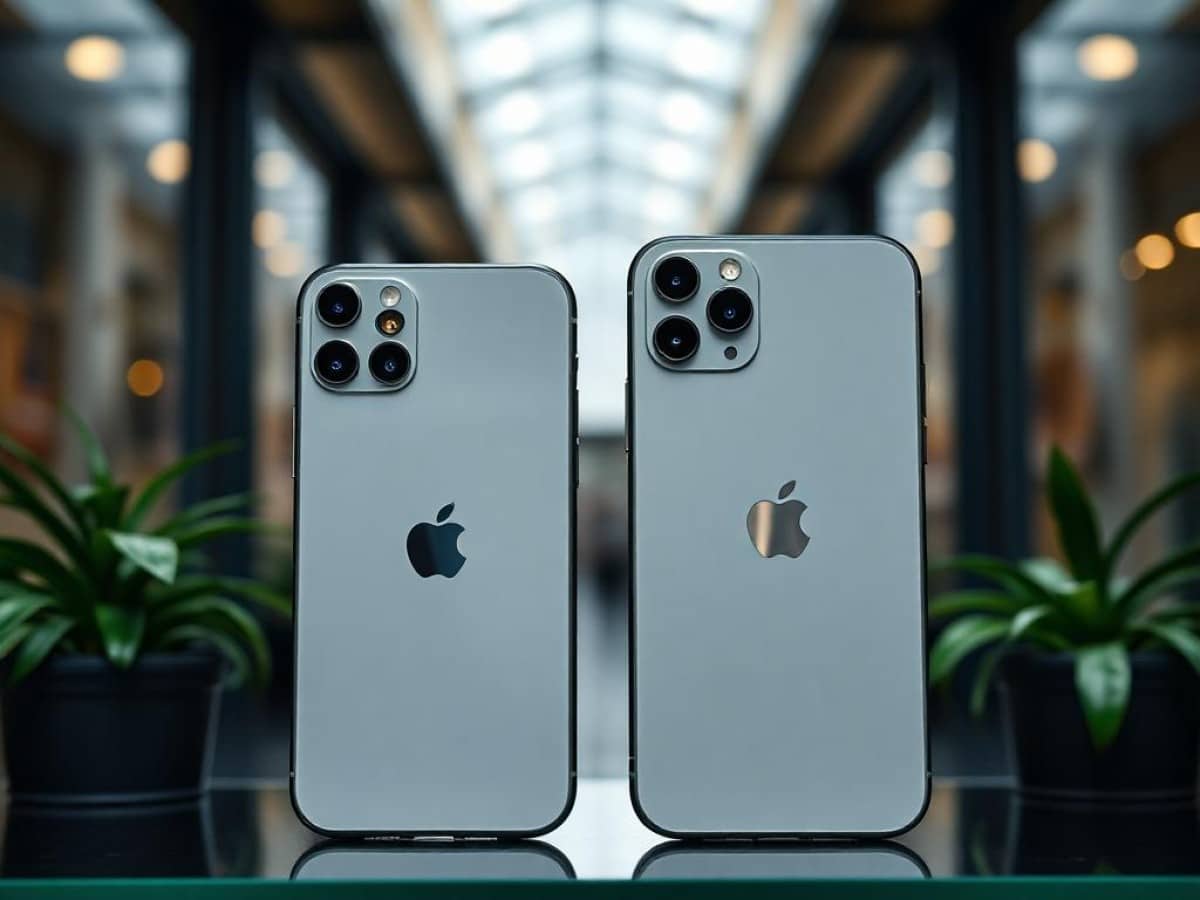
On the back, the difference between the two models is more apparent and not just aesthetic. The iPhone 17 features a classic design with a glass back covering the entire rear of the phone, with only the edge made of aluminum. The iPhone 17 Pro introduces a unibody aluminum chassis that covers the entire back of the phone. The camera module spans the entire available width, and only the lower portion remains glass to maintain compatibility with MagSafe wireless charging. The Pro model is thicker (8.75 mm vs. 7.95 mm) and heavier (204 g vs. 177 g).
The new chassis of the iPhone 17 Pro is designed to improve heat dissipation compared to previous Pro models made of titanium, while also providing better protection for the phone. However, keep in mind that while aluminum is stronger than glass, it is also more prone to scratches: a case is recommended, ideally with protection for the camera module.
In terms of colors, the options vary significantly between the models: there are five shades (black, white, sage, mist, lavender) available for the iPhone 17, but only three (silver, cosmic orange, deep blue) for the iPhone 17 Pro, with no black option.
The Cameras
This is one of the main advantages of the iPhone 17 Pro: the camera system is more advanced than on the standard iPhone 17. If you do not have professional needs for your camera system and do not feel the need for a telephoto lens, the standard iPhone 17 remains well-equipped and can perfectly meet many user requirements.
At the front, both the iPhone 17 and 17 Pro are equipped with the same front camera, which is considerably more advanced than those of previous generations. It has been upgraded from 12 to 18 megapixels with better stabilization and a sensor that improves low-light performance. It also supports new features, including the ability to take photos and videos in landscape mode without holding the iPhone horizontally, dual capture that allows filming both front and rear, and Center Stage which automatically adjusts the framing on FaceTime.
Why You Should Never Reheat These Foods in the Microwave – The Hidden Dangers Experts Warn About
I tried the top 5 guard dogs—here’s what makes these breeds the ultimate protectors
At the rear, the iPhone 17 features a wide-angle and an ultra-wide-angle, while the iPhone 17 Pro adds a telephoto lens and a LiDAR scanner. All sensors on both models offer a 48-megapixel resolution. The zoom level is 0.5x on the ultra-wide-angles, 1x on the wide-angles with a 2x option limited to 12 megapixels, and finally 4x on the Pro model’s telephoto lens with an 8x option also limited to 12 megapixels.
The sensors on the Pro model are larger and provide better results in low-light conditions. The main camera is also better stabilized, which is useful for video but also helps avoid blur in photos. The iPhone 17 Pro supports ProRAW in photos and ProRes RAW in videos, various options used by imaging professionals (ACES encoding, Apple Log 2 video recording, Genlock, slow-motion in Dolby Vision 4K), and comes with a better microphone system for video. The presence of the LiDAR scanner enhances computational photography treatments, in addition to its uses in augmented reality.
The A19 and A19 Pro Chips
The iPhone 17 is equipped with the Apple A19 chip, while the iPhone 17 Pro includes the more powerful Apple A19 Pro chip (about +7% better in CPU and +20% in GPU performance) and features an enhanced cooling system thanks to the unibody aluminum chassis and a vapor chamber. This means that not only is the iPhone 17 Pro capable of greater power, but it can also sustain this power over time without overheating.
Another major difference between the two models is that the A19 chip is paired with 8 GB of RAM while the A19 Pro goes up to 12 GB, which is always beneficial for the most demanding applications. This also makes the iPhone 17 Pro a more future-proof choice compared to the standard iPhone 17.
The A19 Pro chip also supports USB 3, which increases the wired transfer rates of the iPhone 17 Pro to 10 Gbps, compared to USB 2 at 480 Mbps for the iPhone 17. If you regularly handle very large files, this is a significant advantage for the Pro model.
Battery Life and Charging
Battery life is a point in favor of the iPhone 17 Pro, but both models are quite close in this regard. Apple promises a battery life of 27 hours of streaming video and 30 hours of video playback for the standard iPhone 17, or 28 hours of streaming video and 31 hours of video playback for the iPhone 17 Pro. That extra hour can sometimes make a difference at the end of a busy day, but the differences are minimal. To really extend battery life, you would need to switch to the iPhone 17 Pro Max, which offers up to 33 hours of streaming video and 37 hours of video playback, but with a 6.9-inch screen and starting at €1,479.
In terms of charging, there’s no difference: both models can recharge to 50% in 20 minutes according to Apple (in reality, it might take slightly longer) provided they are connected via USB-C to a charger of at least 40 W. MagSafe wireless charging can achieve 50% charge in 30 minutes with a 30 W power adapter.
Storage Options and Pricing
The iPhone 17 is available in two storage capacities at €969 for 256 GB and €1,219 for 512 GB. The iPhone 17 Pro offers three storage options at €1,329 for 256 GB, €1,579 for 512 GB, and €1,829 for 1 TB. Therefore, there’s a price difference of €360 for the same capacity, at least at the official Apple Store rates.
It’s possible that this price difference may increase over time with retailer promotions, as discounts are historically more generous on entry-level models than on Pro models. You can follow the evolution of prices in real time on our price comparison tool, and we relay the best deals daily in our special offers.
So, Which One to Buy?
The iPhone 17 Pro holds several advantages over the iPhone 17, but the technical gap between the standard model and the Pro model has narrowed this year. There’s nothing critically missing from the standard iPhone 17, at least for the uses it is intended for. Photography, and specifically the presence of the telephoto lens, is the only major selling point for the general public considering the purchase of the iPhone 17 Pro. The rest is quite marginal unless you have demanding needs for your phone.
The “Pro” suffix is thus not misused on this new range. If you’re looking for a very good smartphone without specific professional needs, the iPhone 17 will be more than sufficient in most cases. You can certainly indulge in the iPhone 17 Pro, but in that case, you probably made your decision well before reading this article.
Similar Posts
- iPhone 17 Pro Ditches Titanium: What’s Behind Apple’s Surprising Decision?
- iPhone 17: The 6 Key Differences That Could Change Everything for Buyers
- Leaked iPhone 17 Pro Chassis Revealed: Get a Sneak Peek Now!
- iPhone 17 Pro: New Cases Adapt to Lower Logo Placement – See How!
- iPhone 17, Air, and 17 Pro Repair Costs Unveiled: See How Much You’ll Pay!

Ethan Rivers focuses on Android smartphones, emerging mobile platforms, and operating systems. With a critical yet fair perspective, he evaluates devices on performance, design, and ecosystem compatibility.