
Scientists confirm: This is the most effective way to get your cat’s attention, according to new research
Elderly Couple Refuses Reserved Seats—Viral Train Standoff Sparks Fiery Debate on Courtesy
According to the 2025 Cycle Observatory, the average price of an electric bicycle in France in 2024 is 2,045 euros. However, for many French people, this is an investment that’s hard to afford. The temptation to opt for an inexpensive electric bike is therefore significant. And why not consider a highly accessible Chinese electric bike? Brands like Hitway are breaking the price barrier, offering fully equipped models for under 1,000 euros, which are becoming increasingly common on the streets.
Hitway offered us the chance to test their BK8S model, a 26-inch urban bike priced at 699 euros on promotion. What can one expect from a bike priced three times less than the average electric bike?
On paper, the Hitway BK8S boasts a range of 40 km, disc brakes, and good equipment. Of course, it’s unrealistic to compare it with high-end models like the Iweech Avenue or Nakamura Crossover GT, which are priced around 2,000 euros. Do you get your money’s worth, what are the trade-offs with such an electric bike, and what about after-sales service? Find out in our detailed review.
Technical Specifications
| Model | Hitway BK8S |
|---|---|
| Dimensions | 184 cm x 100 cm |
| Motor Power | 250 watts |
| Number of Assist Levels | 3 |
| Announced Range | 80 km |
| Announced Charging Time | 360 min |
| Removable Battery | Yes |
| Bluetooth | No |
| GPS | No |
| Display | Yes |
| Weight | 34.1 kg |
| Color | Black, White, Blue |
| Maximum Supported Weight | 120 kg |
| Headlights | Yes |
| Rear Light | Yes |
| Product Sheet |
This review was conducted using a model provided by the brand.
A Rough Start
Being upfront, the testing experience started off on the wrong foot. Upon receiving the package, and after a lengthy 1.5-hour assembly that created a mountain of plastic and polystyrene, the electric bike we received suffered a serious issue.
Once assembled, the Hitway BK8S had an issue with its disc brakes, which were slightly warped and rubbed excessively against the calipers. As someone not skilled in assembly, and after reaching out to the brand who sent us new discs, we decided to hand the task over to a bike shop.
However, on the way there, we immediately noticed an odd movement at the back. The rim was simply cracked: it was not possible to replace it immediately as it required a specific wheel that accommodates the motor. Eventually, we gave the model to someone in need of spare parts.
Meanwhile, Hitway sent us a second unit. New package, new assembly, and again a problem with the brakes on both wheels. Clearly, it wasn’t due to our assembly. We noticed the absence of a component that would secure the calipers during transport, which we’ve seen on some other unassembled electric bikes. This prologue lasted several weeks, for a test we wanted to complete in less than 15 days. Embarrassing, right?
Hitway BK8S: A Nostalgic Design
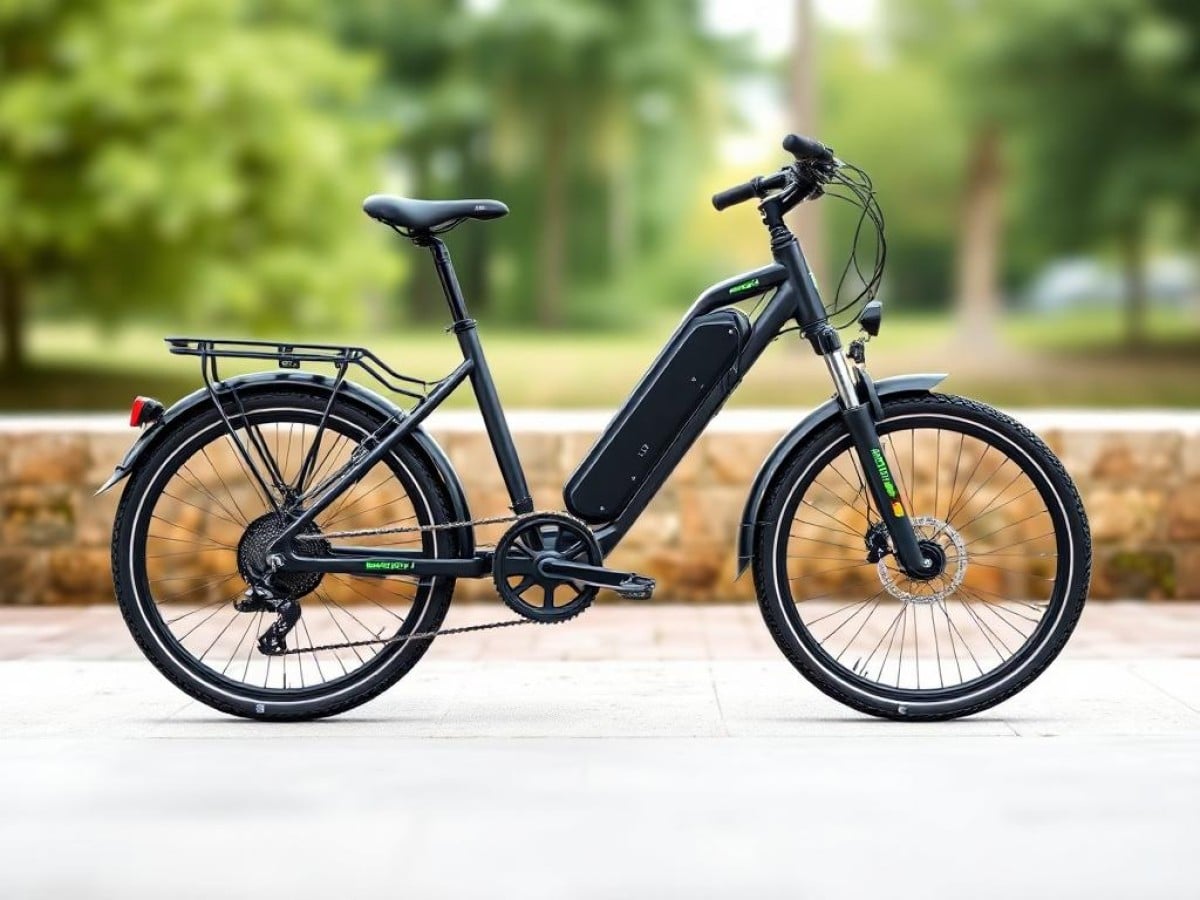
The design of the Hitway BK8S takes us back a decade. Its steel frame incorporates a reinforced diagonal beam with a second tube, but don’t look for the battery there. It is actually placed between the seat tube and the rear wheel, a now outdated choice that reminds us of the Vélobécane Easy. We’re not necessarily talking about style—everyone has their own taste—but about practicality and balance of weight.
Since the motor is positioned at the rear, the electric bike, which we weighed at 27.6 kg (including a 2.87 kg battery), displays a significant imbalance. This complicates handling and affects the riding experience.
With the battery located outside the frame, one might think it would be easy to handle. Not so fast. After unlocking it with a key, you need to tilt the seat forward; otherwise, it’s impossible to remove. Removing it requires a sharp pull upward, but we appreciate the presence of a handle making it easier to carry.
Reinserting the battery requires it to be properly aligned in the track and pushed sharply downward. At least the battery doesn’t move, but we dislike the fact that you need to leave the key in the battery during trips. It can indeed be removed when the bike is turned off.
Automatic Lighting, Robust Equipment
Despite an outdated design that exposes an unattractive brake line, the Hitway BK8S incorporates some of the wiring within the diagonal and rear tubes. A positive aspect: it has good standard equipment. The electric bike includes metal mudguards that don’t move, and a robust stand with a wide foot.
The luggage rack also seems sturdy, but without any indication regarding its load limit. As for the lighting, it is connected to the battery, almost surprising for this price range. However, the brightness of the adjustable headlight is too weak for riding outside the city.
A Display from Another Era
The Hitway BK8S offers no connectivity—and at this price point, we wouldn’t expect much—which means the experience is limited to a display, installed on the left side of the handlebar. It’s an LCD screen, monochrome and not particularly attractive, but it’s perfectly readable during the day, even in sunlight, and its backlight helps at night. It displays speed, battery level, and assist level prominently, with a few additional details.
To navigate it, make sure to read the manual. A simple press of the central button scrolls through the mileage and volts (which, let’s be honest, isn’t very useful), but accessing average and maximum speed requires playing with the two top buttons. Be careful not to confuse them, as the top button controls the lighting and the bottom one the walking mode.
We also noted a strange phenomenon, as the speedometer never exceeds the assistance limit. Even if you’re going downhill at 35 km/h, the display shows 25 km/h in mode 3 or 15 km/h in mode 1. Thus, you need to add an additional speedometer or use your smartphone to know your actual speed.
A Sensor That Misses the Mark
Among the compromises made by a 700-euro electric bike, there’s obviously the type of sensor: here, it’s a rotation sensor. But the experience can vary greatly from one model to another. Excellent with very little latency on a Lemmo One, good on a Decathlon Rockrider E-ACTV 100, the latency is very poor on this Hitway. Indeed, it takes 2 full pedal rotations for the motor to engage, an eternity with the single-speed transmission at start-up. This is almost unprecedented.
The NCM C5 we tested, also equipped with a rotation sensor, did not suffer from such a glaring flaw despite its similar price of around 750 euros.
The same goes for the motor stopping: there’s a noticeable delay of several seconds after you stop pedaling. Thus, the ride feels effortless due to the on/off effect of the rotation sensor.
This setup might suit many beginners who want a simple everyday electric bike. But here, the calibration is quite clumsy, as simply pedaling without pressure on the pedals causes the BK8S to move on its own. As a result, it gives a moped-like effect where the legs are spinning aimlessly.
On the other hand, the rear motor (32 Nm of torque) is quite eager on slopes, even though additional pedal power is needed on steep inclines. The unit is a bit noisy, but not excessively, with 3 modes similar to those found in the scooter world. Each mode limits the maximum speed rather than the power of the assistance level.
Mode 3 tops out at 25 km/h, mode 2 at 20 km/h, and mode 1 at 15 km/h. By digging into the screen menu, it’s possible to unlock a 5-mode system with no speed limit, which calibrates the power. A walking mode is also available.
Beyond the motor and performance, we need to revisit the brakes. Riding this Hitway is quite tricky, as the front caliper poorly grips the disc, while the rear, more compliant, is still underperforming. The BK8S thus requires cautious riding, necessitating anticipation in every risky situation. It takes more than 10 meters to come to a stop, which is unacceptable for a modern electric bike.
Stable but Uncomfortable
With its small fixed fork, thin diameter tubes, the Hitway BK8S is quite uncomfortable. We prefer to avoid poorly maintained streets and small paths as the electric bike transmits all imperfections into the arms and buttocks. It’s a shame, as the seat is cushy and invites long journeys, but it lost its small suspension present on the earlier 2024 model (which we initially received).
With a better fork or a handlebar that dampens vibrations more effectively, there would be potential as the tires are wide. These tires, of unknown origin, adhere well to the road in rainy weather, and the BK8S remains quite pleasant to maneuver.
We note, however, a front part that’s too light, which the active riding position compensates for (since one leans heavily on the handlebar). This dynamic position isn’t disturbing—some may appreciate it—but it contradicts the spirit of a comfortable urban bike that Hitway promises.
More Range Than Expected
The main update of the 2025 Hitway BK8S is a battery with a capacity of 10.4 Ah (374 Wh), replacing the 8.4 Ah model from 2024. This allows the brand to promise a minimum of 40 km in mode 3, and up to 80 km in mode 1. On our standard 40 km route, we just had enough distance to test this model.
Ultimately, it exceeded this limit, reaching even 50 km before the battery died. The test was conducted under ideal conditions, with bright sunshine and 25°C, with a cyclist weighing about 80 kg, including a bag.
However, tracking the battery level is somewhat imprecise due to an old-generation BMS (battery management system). Thus, the 5-bar gauge can vary whether you’re riding or not, while the 20% increments are not very accurate. For example: after our 40 km trip and a short rest, the gauge showed 3 remaining bars. In the first few pedal strokes, it dropped to 2 bars, then to the last bar after only a handful of kilometers.
When recharging, the situation is even more disappointing, as the bike turns off as soon as it’s plugged in. It’s therefore impossible to follow the charge level; you have to plug and unplug everything to check the state of charge.
Charging Time Between 5 and 6 Hours
The bike can be charged either directly or with the removable battery. The charging port is located on the battery, with a charger measuring 2.30 meters, slightly below average. The charger has a conventional power, with a 2-amp current and 84 W.
This charger gets quite hot, especially during our testing period. It is therefore advisable to let it rest for a few minutes after charging. The full battery charge of the BK8S is in line with what Hitway claims, about 5 hours and 45 minutes.
Spectacular Price, Nonexistent Service
The main advantage of this electric bike is its price, which is simply unbeatable. At 699 euros, the Hitway BK8S is one of the most affordable electric bikes on the market. However, its availability is only online, making it impossible to test before buying or to see it at a dealer.
The BK8S is available in one size, and theoretically in 3 colors: black, blue, and blue (with color bands). Optionally, it’s possible to order a front basket (40 euros), a rear basket (50 euros), and a second larger capacity battery (15 Ah).
Shipping is free and takes between 3 and 7 days according to the brand, while the warranty is the minimum legal period of 2 years. However, the customer service remains very unclear. The official website does have a page… filled with “Lorem ipsum” without any information. Thus, one must rely solely on an email address at the bottom of the page.
We add that the brand seems to be suffering from a reliability issue, as the VAEs (electrically assisted bicycles) age poorly over time (especially the folding models) according to some owners we’ve spoken with. Some have confirmed that it’s quite easy to unlock the models from this manufacturer, but we were unable to unlock the BK8S despite our attempts.
Additionally, during our numerous exchanges with several bike shops, many simply refuse to work on Hitway electric bikes (or those from the sister brand Koolux).
Hitway BK8S
at the best price
There are no offers at the moment, discover
-
Trek FX Plus
879 €
7/10
Read the review -
Decathlon Rockrider E-ACTV 900
- We Tested the Starway Pliant: Discover This Unique Electric Bike’s Excellence!
- Riding an E-Bike That Drives Like a Car: Experience a Unique Driving Sensation!
- We Tested the Anod Hybrid 2: World’s Fastest Charging Electric Bike!
- We Tested the UTO PRO20 (Formerly Eovolt): A Near-Perfect Foldable Electric Bike
- We Tested Lapierre’s Top Electric Mountain Bike: It Conquers Every Trail

Maya Singh is a senior editor covering tablets and hybrid devices. Her work explores how these tools reshape digital productivity and learning. She also contributes to feature editorials on emerging tech.
Categories
Latest Articles