
Scientists confirm: This is the most effective way to get your cat’s attention, according to new research
Elderly Couple Refuses Reserved Seats—Viral Train Standoff Sparks Fiery Debate on Courtesy
With a slew of new products launched earlier this year, Segway-Ninebot is aiming to solidify its leadership in the electric scooter market. Having previously tested the high-end Ninebot Max G3 and the smaller Ninebot F3, it was time to explore the entry-level model.
The Ninebot E3 represents a significant upgrade over its predecessor, improving in motor power, battery life, display features, and notably introducing dual suspension at this price point. Yet, it strives to remain affordable, as sub-500 euro models still account for three-quarters of sales in 2024.
Priced at 399 euros, the E3 is Segway-Ninebot’s new generation entry-level ticket to electric scooters, leaving room for the older E2 models (priced between 319 to 349 euros). We decided to review the Ninebot E3 Pro E model, priced at 449 euros, which differs only in its battery capacity (368 vs 276 Wh).
Is this Ninebot E3 Pro E the new benchmark in its price range against competitors like Xiaomi, Navee, or Niu? Frandroid took the electric scooter for a spin over more than 70 kilometers to find out. Here is our complete review.
Technical Specifications
| Model | Segway-Ninebot E3 Pro E |
|---|---|
| Advertised Range | 55 km |
| Advertised Recharge Time | 420 min |
| Top Speed | 25 km/h |
| Motor Power | 800 watts |
| Maximum Load Capacity | 100 kg |
| Product Details |
This review was conducted using a product lent by the brand.
Stylish Electric Scooter
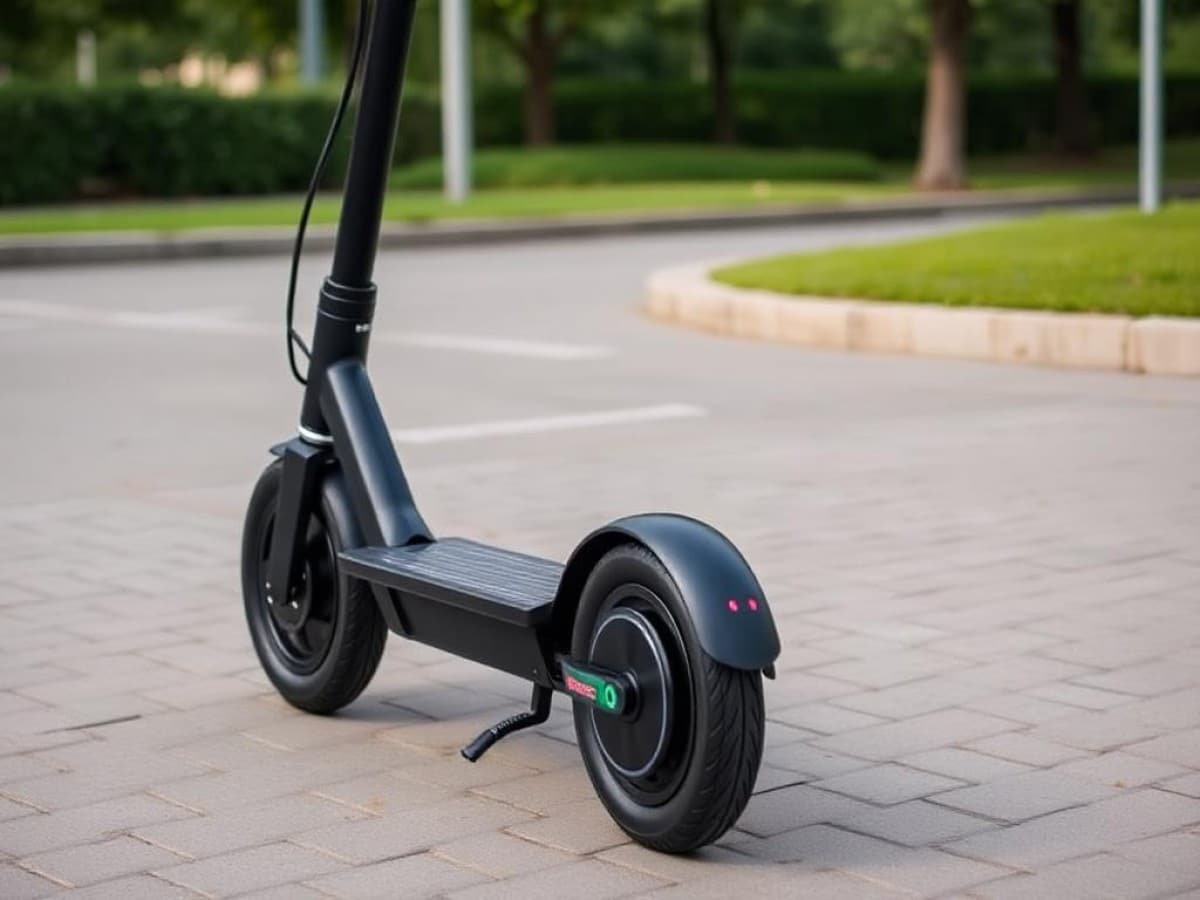
The design of the Ninebot E3 aligns with other models in the range: light gray as the primary color with red pivot points on the suspension. It introduces two new features: a suspended fork at the front and a swinging arm at the rear.
The suspensions slightly raise the ground clearance (10 cm) while maintaining a long deck of about 52 cm. The deck doesn’t offer a raised rear section, which is a shame, but it does have a front section. Our size 45 feet fit easily, but the 15 cm width is a bit narrow for keeping feet parallel.
Typically, the stem integrates the front light, which features automatic activation and a broad beam (1.50 m at a distance of 3 meters), while the rear light includes a stop function for added safety.
Turn signals are included but are not very visible. The handles lack width, so large hands or gloves can easily cover the turn signals. The control under the right thumb is quite intuitive, with an audible reminder to turn them off.
The E3 Pro E Sheds Some Weight
The folding mechanism of the Ninebot E3 Pro E returns to a system we thought was obsolete. No folding stem here; instead, the brand opts for a latch at the front of the deck, which is activated by foot.
This design allows for a lower folded height (45 cm vs. an average of 55 cm), even if it increases the length by 10 cm when folded. The format is stable as it rests on the underside of the deck, not on the kickstand. The fold is symmetrical, with a hook to secure the steering column, and the weight distribution makes it easier to carry.
Transport is feasible for short distances given its weight of 17.9 kg. Segway has opted for a magnesium frame, saving 900 grams compared to the Ninebot E2 Pro. This is notable considering the brand has integrated dual suspension and a larger battery. However, the maximum load remains at 100 kg.
Large Display
Given its price, the E3 Pro E cannot boast the same high-quality display as its more expensive siblings. Nonetheless, the “little” Ninebot is equipped with a new panoramic display, very similar to the Segway ZT3.
The main upgrade is a more accurate battery gauge with 10 bars, while traction control now features its own indicator light. The display is easy to read due to the large characters, although it lacks a bit of brightness during the day when the lights are on (which adjust automatically).
An Ever-Improving App
Having tested it multiple times during our previous reviews of Segway-Ninebot electric scooters, the app still deserves mention as it continues to evolve. The graphics have slightly changed since last year, highlighting the battery level and remaining autonomy in kilometers.
The app provides access to a dynamic meter and several additional pieces of information. However, it lacks trip recording capabilities offered by some competitors. Nonetheless, it is possible to access extensive information about the electric scooter or lock the motor for short stops.
For iPhone or other Apple device users, the scooter includes an Apple Find My tracker.
A Ninebot with Lively Acceleration
The motor of the Ninebot E3 Pro – identical to the E3 E version – delivers a high power of 400 W for an electric scooter in this price range. At peak, it reaches 800 W, although this is not apparent at startup.
It starts off a bit slow but soon picks up speed briskly to reach 25 km/h within a few seconds. On steep inclines (over 8%), it’s hard to reach the top speed but it maintains a good 22-23 km/h, which is excellent.
Stable but Lacking Comfort
The E3 Pro E is stable and quite enjoyable to ride. Like the F3 and G3, it features a slightly offset fork. The 10-inch wheels with 2.3-inch wide tires provide reassurance both in turns and under heavy rain.
The small elastomer suspensions add some welcome cushioning compared to a rigid model, but they don’t work miracles. The increase in comfort disappears on rough surfaces or cobblestones, though stability is maintained.
Overall, it offers a good riding experience, even if the braking could be improved. The single drum brake is too weak for absolute emergency stops, requiring one to jump off the scooter to avoid accidents (from our own experience).
At 25 km/h, we measured a stopping distance of 5.80 m, compared to 2.60 m at 15 km/h. This was recorded with braking regeneration on the medium level.
Editor’s Note: Segway has responded to this issue, stating that this pre-series model might lack the braking power of current production models.
Very Decent Autonomy
Under the deck, the 368 Wh battery is capable of transporting you over 55 kilometers. Of course, this is a theoretical value based on a journey at 15 km/h on flat terrain. In practice, we rode in S mode limited to 25 km/h, with multiple accelerations and some slight inclines.
On the same terrain as the E2 Pro E – equipped with a smaller battery – the Ninebot E3 Pro E is able to exceed 30 km (33 km exactly). This is with perfect weather, but already loses 5 km under 20°C with rain. On average, we achieve 31.3 km on our various trips.
This remains a very satisfactory autonomy, but Segway slightly frustrates us when the charge level drops below 10%: the power drops significantly, so much so that it’s hard to exceed 20 km/h, and riding becomes nearly impossible below 5%.
Standard Recharge
Recharging is done via a small 1.7 A, 41 V charger, theoretically providing nearly 70 W of power. In practice, however, there are differences. The app’s meter shows real-time power at 57 W, gradually climbing to 66 W at 95% charge.
It takes about 2.5 hours to reach 50% energy (starting from 5%), 4.5 hours for 80%, and 6 hours for a full battery charge. Monitoring the charge is very easy, as both the display and the app show the percentage.
Well-Balanced Price-Performance Ratio
The Ninebot E3 Pro E confirms the rapid transformation of the electric scooter segment. Despite improving numerous features, it maintains the same price as its predecessor.
Priced at 449 euros, it is poised to maintain Segway-Ninebot’s dominant position against competitors. The E3 Pro competes with Xiaomi Electric Scooter 5 (priced at 409 euros), the Niu KQi 200P (449 euros), and the Navee GT3 (499 euros).
| Ninebot E3 Pro E | Xiaomi ES 5 | Navee GT3 | Niu KQi 200P | |
| Power/Peak | 400/800 W | 350/700 W | 350/700 W | 350/700 W |
| Wheels | 10” | 10” | 10” | 10” |
| Braking | Drum + eABS | Drum + eABS | Drum + eABS | Drum + eABS |
| Suspension | Front/Rear | Front | Front/Rear | Front |
| Battery | 368 Wh | 477 Wh | 358 Wh | 365 Wh |
| Range at 15 km/h | 55 km | 60 Km | 50 km | 54 Km |
| Weight | 17.1 kg | 20.1 kg | 21 kg | 19.7 kg |
| Water Resistance | IPX6 | IPX5 | IPX5 | IPX5 |
| Price | 449 € | 409 € | 499 € | 449 € |
It is also available in the “Ninebot E3 E” version, which sees its range reduced to 45 km (theoretically) due to a smaller battery (276 Wh). Priced at 399 euros, it still poses a significant challenge to the competition.
Both versions of the E3 come with a 2-year warranty on the main components of the electric scooter (frame, motor, battery). This does not include wear-and-tear parts such as tires, brakes, or handles.
Finally, the after-sales service has its own dedicated website, where customers can request repairs or check their warranty. There is also a specific site for the availability of spare parts. One couldn’t ask for more!
Segway-Ninebot E3 Pro E
at the best price
-
Fnac
399 € -
Darty
399 € -
Rakuten Marketplace
395 € -
Pixmania Marketplace
446 €
Similar Posts
- We Tested the Anod Hybrid 2: World’s Fastest Charging Electric Bike!
- $700 Electric Bike Review: Is It Really Worth Your Money?
- Tested: Peugeot 3008 Dual Motor Electric – Unveiling the French SUV’s 4×4 Version!
- Unbelievable Kindle Deals Starting at Just €92: Get the Best Prices on Color and Stylus Options!
- Dacia Spring Review: Is France’s Cheapest Electric Car Still Overpriced?

Maya Singh is a senior editor covering tablets and hybrid devices. Her work explores how these tools reshape digital productivity and learning. She also contributes to feature editorials on emerging tech.