
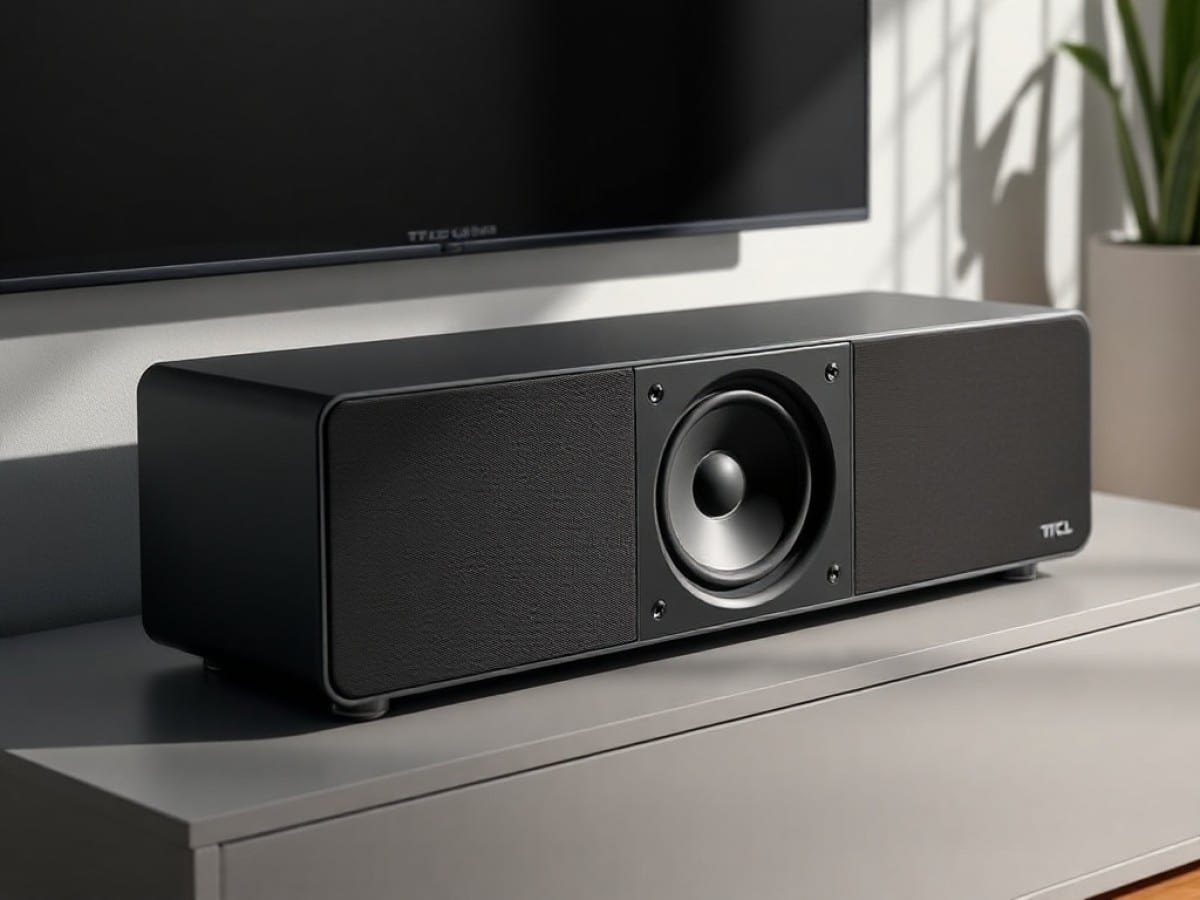
TCL is set to revolutionize wireless home cinema with its Z100 speakers, available individually or in up to four compact modules designed for Atmos and suited for any living room. It remains to be seen whether this modular solution, designed for the brand’s TVs but also usable independently, truly holds up against the high-end soundbars on the market.
Scientists confirm: This is the most effective way to get your cat’s attention, according to new research
Elderly Couple Refuses Reserved Seats—Viral Train Standoff Sparks Fiery Debate on Courtesy
The TCL Z100 speaker is a wireless model designed as a natural extension of certain Mini LED TVs from the brand, promising true Dolby Atmos immersion without the need for a massive soundbar or a complex home cinema amplifier.
In practice, these are compact modules that can be freely placed around the living room, with the TV’s electronics analyzing their position and automatically recalibrating the sound stage to recreate a coherent multi-channel field around the viewer. You can start with two modules and add two more later if your budget doesn’t allow for a complete setup from the start.
This “TV + satellite speakers” approach positions it halfway between premium Atmos soundbars and traditional home cinema kits, with the goal of maintaining a clean living room almost free of visible cables. This is the first model on the market to offer the Dolby Atmos Flex Connect concept.
The TCL Z100 system directly competes with new “full satellite” wireless home cinema systems like the Hisense HT Saturn or the Sony Bravia Theatre Quad. While Hisense offers a very complete package with four speakers and a dedicated subwoofer, designed to work with any TV, TCL bets on a much tighter integration with its own TVs, making the Z100 a native audio extension of the screen rather than a universal system.
Compared to the Sony Quad, which clearly plays the high-end card with extremely sophisticated spatialization and a significantly higher price, the Z100 appears as a more accessible and modular alternative, designed to democratize Atmos without multiplying boxes and cables.
In practice, it fills the gap between premium soundbars and the most luxurious wireless home cinema kits, mainly addressing TCL TV owners who want to upgrade to true immersive multi-channel sound without the complexity of a traditional amplifier and speakers. Let’s see what this four-speaker TCL Z100 pack really offers.
TCL Z100 Technical Specifications
| Model | TCL Z100 |
|---|---|
| Number of speakers | 4 |
| Subwoofer | Yes |
| Wifi | Yes |
| Color | Blue, Grey, Beige |
| Product sheet |
TCL Z100 Design
The TCL Z100 speaker sports a decidedly sleek and contemporary design, meant to blend into the living room rather than stand out as a bulky home cinema component. Each speaker is a compact vertical module with straight lines softened by slightly rounded corners, dressed in acoustic fabric on the front and a matte shell on the sides.
This material combination offers a discreet and modern look, far less imposing than a large soundbar or a set of column speakers, which greatly facilitates integration into an already crowded TV stand or a minimalist living room. Positioned on a sideboard, at the foot of the TV, or in a corner of the room, the Z100s never visually dominate the space. Each speaker measures 137.6 x 132.6 mm with a height of 301.6 mm.
On the top part, there is a grill allowing the height sound to escape, and there are also several buttons for powering the speaker, managing the volume, pairing, or changing the source (Wi-Fi for a connection with the TV/Bluetooth for purely audio listening).
The integration is even more successful because the system does away with any visible central unit and cumbersome audio cables: each speaker only needs a power outlet, with the TV serving as the system’s brain. However, it is essential that the TV is compatible with Dolby Flex Connect: C6K, C7K, C8K, C9K, and X11K (2025 models).
This approach starkly contrasts with a Hisense HT Saturn or a Sony Quad, which rely on a dedicated hub and a more “classic home cinema” architecture. The Z100 thus literally blends into the TCL ecosystem: the speakers seem to be a natural extension of the TV, rather than a separate system added on top. This minimalist philosophy clearly appeals to those who want a clean living room, free of cables running along the walls or large boxes to hide behind a sofa.
The modularity is also an integral part of the design. The Z100s are compact and light enough to be easily moved around, depending on the living room’s rearrangement or the use (movie night, gaming session, more intimate music listening). Their base ensures perfect stability on furniture, and their vertical silhouette takes up very little depth, allowing them to be placed close to a wall or in passageways without obstructing movement.
Where the Hisense HT Saturn pack immediately imposes a more fixed configuration (four satellites + subwoofer, with a clear front/back logic), the TCL Z100 allows for more free placement, with the calibration intelligence then taking care of exploiting this freedom to adapt the sound stage to the room and listening position.
TCL Z100 Connectivity and Setup
The Z100 does away with traditional connections: no HDMI, no audio cable, each speaker only requires a power supply. The cables could be a bit longer to avoid having to use an extension cord, if necessary.
The setup is radically simplified: just pair each module by Wi-Fi with the compatible TCL TV (Mini LED C6K and later), and the automatic calibration takes care of the rest.
After indicating the distance between your sofa and the TV, the Dolby Atmos FlexConnect technology analyzes the room and the position of each speaker to adapt the sound spatialization. The operation takes just a few seconds. At the end of the calibration process, a simplified map of the room with the estimated position of each speaker is displayed on the TV. Each speaker can be renamed for easier identification, if necessary.
For music listening, the Z100 also functions as a Bluetooth stereo speaker with smartphones or tablets. If you move one of the speakers, it is then necessary to restart the calibration from the TV settings.
TCL Z100 Remote Control and Application
The operation of the TCL Z100 relies almost entirely on the TV they are paired with, and this is where the “remote control and software” part comes into play. Unlike a Hisense HT Saturn or a Sony system with a dedicated remote for the audio hub, here, no additional controller clutters the TV stand: everything goes through the TV remote and especially through the software interface in the audio settings.
Note that there are no specific options, so it’s impossible to adjust the speakers’ frequencies, for example. Everything is preset and automatic, which simplifies its use. Here, there’s no need to juggle multiple remotes or remember the active source on an intermediary device. When the TV turns on, the Z100s wake up and sync automatically.
However, this dependence on the TV interface also has a downside: no dedicated mobile app to control the speakers independently, no advanced multiroom management, nor complex audio scenarios like those found in some more open, competing ecosystems. The TCL Z100s therefore focus on very smooth and integrated usability on the TV side, at the cost of some closure for those who like to control everything from a smartphone or mix several brands within the same audio system.
TCL Z100 Internal Design
The internal architecture of the TCL Z100 follows a logic common to modern Atmos systems but with an implementation designed to remain compact and modular. Each speaker is designed as a small “3-way system” (1.1.1 channels), capable of handling part of the frontal message, height effects, and a portion of the bass range, independently of a soundbar or centralized subwoofer.
In the front part, a full-range driver is paired with a small-diameter woofer and a dome tweeter ensuring detail precision, timbre fidelity, and dialogue clarity. This front section primarily works in direct field towards the listener, which guarantees good intelligibility even when the speaker is placed on furniture or slightly off-center.
The most notable feature of the speaker is the presence of a last upward-facing transducer, slightly angled, dedicated to Dolby Atmos height effects. This full-range speaker is optimized to project sound towards the ceiling so that it reflects down towards the listening area, creating the illusion of sound objects coming from above (rain, helicopters, room reverberations, etc.). According to TCL, the available power per speaker is 170 W, which is more than enough for a standard-sized living room, each module having its own amplification stage and local digital processing controlled by the TV.
The Dolby Atmos FlexConnect algorithm dynamically distributes the workload among the Z100s: some speakers are given more bass or height depending on their placement, others reinforce the frontal or surround coherence.
The result is a setup in which no speaker has a “fixed” and rigid role of a front or rear channel, as in a classic 5.1 kit. The intelligence of the system lies precisely in leveraging this symmetrical internal architecture to redistribute roles: if a Z100 is placed near the TV, it will take more charge of the frontal message; if it is far away, it may be assigned more ambiance or height effects.
This flexibility, made possible by the combination of several transducers per speaker, onboard amplification, and advanced software control, differentiates the Z100 approach from systems like Hisense HT Saturn or Sony Quad, where the channel hierarchy (front, rear, subwoofer) is fixed.
TCL Z100 Listening Experience
The listening experience with four TCL Z100s primarily relies on the sound bubble sensation that this system manages to create despite its apparent simplicity. In an action film like “Top Gun: Maverick” in Dolby Atmos, the initial flight sequences immediately highlight the Z100s’ ability to project sound beyond the screen.
Thus, the jet engines move laterally from one speaker to another, the flyovers seem to really pass over the sofa, and the dialogues remain solidly anchored in the center, even without a dedicated central channel. By turning up the volume, the system maintains good clarity, the speakers show no signs of premature saturation, and the ensemble maintains a convincing balance between spectacular effects and voice clarity.
In more dialogue-heavy series like “The Last of Us” or “Succession,” the Z100s’ contribution is mainly measured in the subtlety of the ambiences. Footsteps in a hallway, rain in the background, a whisper in another room: all these elements stand out better than with the built-in TV speakers, and the scene really seems to open up around the viewer.
The four calibrated modules manage to envelop the listener without giving the impression that the sound comes from a specific point, which enhances immersion in dialogues and environments. Even in an asymmetrical living room, the system adapts surprisingly well, allowing for quite free speaker placements without too much concern.
In terms of music, the TCL Z100s display a rather clean and dynamic rendering, especially with pop, electro, or orchestral soundtracks. A track like “Blinding Lights” by The Weeknd offers a beautiful amplitude. The bass line is better seated than with the simple TV, the synths extend more widely in the room, and the voice remains very legible.
On more acoustic tracks (jazz, folk, voice-guitar), the reproduction is pleasant but a bit less warm than a dedicated hi-fi system. Note that, for us, the Z100s prioritize precision and spatialization over warmth, and the absence of a real subwoofer is sometimes felt on double basses or kick drums. However, this remains very satisfactory for everyday listening, especially if you often alternate between series, movies, and playlists.
In video games, the system proves particularly convincing. In a title like “Call of Duty,” the Z100s allow for very clear localization of where shots, enemy footsteps, or approaching vehicles come from. The sound stage naturally follows the camera movements, which enhances the sensation of presence in the game’s universe.
The audio latency remains low enough not to be bothersome, and the system maintains good clarity even when the action becomes chaotic. While not the most demonstrative kit in terms of “big bass that shakes the sofa,” for everything related to spatial precision and clarity, it offers a very interesting rendering compared to a basic soundbar or, of course, the built-in TV speakers.
In the end, the listening experience with four TCL Z100s is characterized less by a display of raw power than by well-managed immersion and true versatility. The system excels at creating a coherent sound field around the viewer, whether for movies, series, or games, while offering clean and sufficiently ample musical reproduction for most home uses. Those looking primarily for very deep bass will need to supplement with a subwoofer or turn to more robust systems, but for mixed cinema/music everyday use, the compromise is very solid.
TCL Z100 Release Date and Price
The TCL Z100 speakers are currently available for a price of 249 euros each. The pair is offered at 479 euros.
at the best price
-
Boulanger
249 € -
Son-Vidéo.com
249 € -
Fnac
250 € -
Pixmania Marketplace
249 € -
Fnac Marketplace
249 €
Similar Posts
- Sharp HT-SBW320 Review: Extreme Slimness at the Cost of Immersion
- Hisense HT Saturn Review: Could This Be the Ultimate Wireless Home Cinema Experience?
- Samsung Q995F Review: Experience 11.1.4 Channel Immersion and Musical Excellence!
- Harman Kardon SoundSticks 5 Review: Iconic Design Meets Modern Hi-Fi, Transforming Living Room Audio!
- Sonos Sale Alert: Discounts on Speakers, Soundbars, Subwoofers & Headphones!

Maya Singh is a senior editor covering tablets and hybrid devices. Her work explores how these tools reshape digital productivity and learning. She also contributes to feature editorials on emerging tech.