
Scientists confirm: This is the most effective way to get your cat’s attention, according to new research
Elderly Couple Refuses Reserved Seats—Viral Train Standoff Sparks Fiery Debate on Courtesy
Having previously reviewed the Ultra Core X9, one might wonder how the Core X7 performs, especially in a compact 14-inch format that presents considerable thermal challenges. MSI provides insights into this with the Prestige 14 Flip AI+, a device that stands out on its own without necessarily needing the new Intel chip.
Technical Specifications
| Model | MSI Prestige 14 Flip AI Plus |
|---|---|
| Dimensions | 315.6 mm x 13.9 mm |
| Resolution | 1920 x 1200 pixels |
| Display Technology | OLED |
| Touch Screen | Yes |
| Processor (CPU) | Core Ultra X7 358H |
| Graphics Chip (GPU) | Intel Graphics |
| RAM | 32 GB |
| Internal Memory | 1024 GB |
| Appearance | Metal |
| Operating System (OS) | Microsoft Windows 11 |
| Weight | 1370 grams |
| Depth | 221.95 mm |
| Product Sheet |
Design
2026 marks a significant year for MSI as the manufacturer has completely revamped the design of its Prestige series. The MSI Prestige 14 Flip AI+ we’re reviewing is one of three devices unveiled at CES 2026 set to release in the coming months. True to its name, it features a 2-in-1 design allowing you to fold the screen back to switch between laptop and tablet modes.
The entire range now includes a stylus integrated directly into the chassis, a brilliant move by MSI. This thin stylus comes standard and charges via two conventional Pogo ports embedded in the chassis elevators. Though it takes some getting used to for perfect placement, it becomes second nature to use when needed.
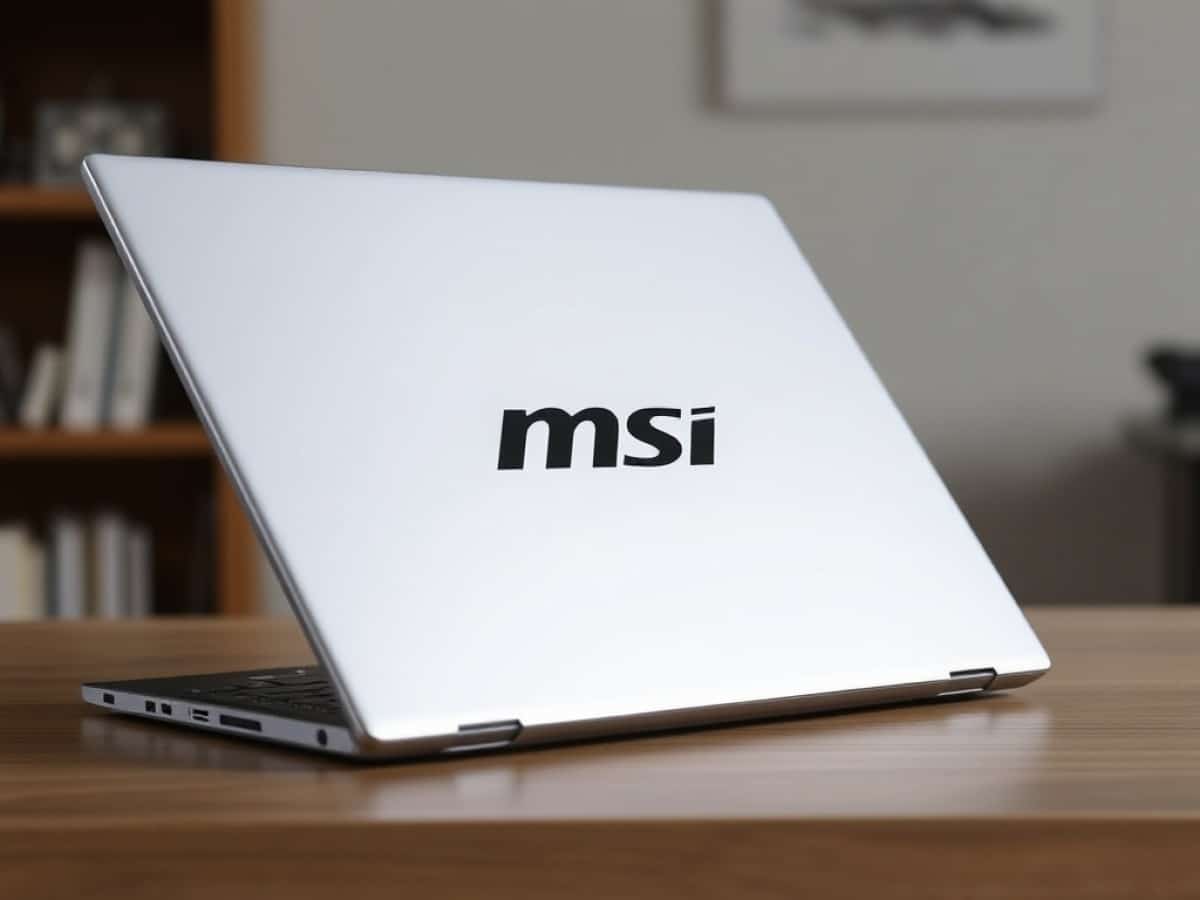
This year, MSI has also embraced a more rounded design aesthetic as opposed to the more angular style of previous models. The edges and contours are smoother, reminiscent somewhat of Lenovo’s design philosophy. The emphasis is on simplicity and power, with a significantly large exhaust at the back and a newly designed, more calligraphic MSI logo adding a touch of elegance.
Aside from these design updates, this is still very much a modern ultraportable: a 14-inch, 2-in-1, weighing 1.37 kg and just 1.39 cm thick. The specifications are impressively met in a beautifully executed design.
Keyboard and Touchpad
The keyboard switches offer a pleasing rigidity when typing, although they may lack a bit of travel for those with a heavier touch. Some acclimatization is required, but the stability and layout are excellent.
The touchpad also impresses, with customizable edges that can be programmed for shortcuts like brightness or volume control. It’s thoughtfully designed and enjoyable to use.
Ports and Connectivity
On the left side, there’s an HDMI 2.1 port and two Thunderbolt 4 ports. The right side houses two USB A 3.2 Gen 2 ports and a combo jack.
This setup is straightforward yet effective for a 14-inch model. A USB-C port on each side would have been a nice touch for more versatile charging, but this is a minor quibble.
Webcam and Audio
The device features a standard 1080p sensor compatible with Windows Hello facial recognition. There’s also a fingerprint reader. The video quality has a somewhat oily look typical of AI enhancements, but the dynamic range is decent.
The four speakers, unfortunately positioned at the bottom of the chassis, are not extraordinary but perform adequately. It’s typical for ultraportables of this size, with somewhat enhanced trebles and soft mids, but the overall audio profile isn’t optimized for exceptional sound quality. Still, they are quite serviceable.
Display
The MSI Prestige 14 Flip AI+ features a 14-inch OLED display with a maximum resolution of 1920 x 1200 pixels, a 16:10 aspect ratio. It’s touch-enabled, offers a refresh rate of 60 Hz, and is not HDR compatible.
Using our probe and CalMAN software by Portrait Displays, we observed a coverage of 176% of the sRGB space and 118% of the DCI-P3 space. The manufacturer prioritizes sRGB, but the panel natively supports a broader range.
The average color temperature is a slightly warm 6006K compared to the NTSC standard of 6500K, with an excellent average delta e00 of 2.72, despite a maximum deviation of 8.28 observed in royal blue tones.
The display is commendable, though it could benefit from a higher refresh rate and improved brightness, particularly for outdoor use. The lack of HDR support is not a significant issue, as it tends to be poorly calibrated in laptops anyway.
Software
The MSI Center software remains the focal point of system management, standing out as one of the better utilities in its class. It’s user-friendly, and the AI mode is handy for managing the device’s power “automatically,” offering all one could ask for.
And, of course, the usual pre-installed advertising software is present. Here, Norton makes an appearance, which we recommend uninstalling promptly.
Performance
The big news here is the Intel Core Ultra X7 358H, a new 16-core SoC from Intel — 4 performance cores, 8 efficient cores, 4 low-energy cores — and 16 threads that can turbo up to 4.8 GHz. It’s paired with 32 GB of LPDDR5X RAM at 8633 MT/s, the renowned Intel Arc B390 graphics with 12 compute units, and 1 TB of PCIe 4.0 storage.
This configuration is a more “accessible” version of the previously tested Core Ultra X9, at least within the “X” series that benefits from the integrated Arc B390.
Benchmarks
In Cinebench 2024, we see scores of 913 points in multi-core and 121 points in single-core, continuing the trend seen with the Ultra X9: a slight improvement, though not groundbreaking.
These scores in Cinebench 2026 are 3763 points in multi-core and 501 in single-core, essentially matching the performance of the previous generation’s Ultra 7 255H. Like the Ultra Core X9, a significant advantage of this generation is maintaining power even on battery! Unplugged, the scores are 3861 points in multi-core and 499 in single-thread: almost no loss.
In 3D, we see a score of 6123 points on Steel Nomad Light, comparable to the Core Ultra X9 integrated into a 16-inch format. Promising, except that at launch, the MSI Prestige 14 Flip AI+ doesn’t quite keep up. Its conservative thermal management doesn’t allow the graphics card to fully express itself over long periods. Hopefully, the manufacturer will adjust its fan curves to give more leeway to the Intel Arc B390, which seems quite comfortable in a 14-inch format nonetheless.
The storage memory delivers the expected performance from PCIe 4.0.
Gaming
| 1080p | Black Myth Wukong | Cyberpunk 2077 |
| High, XeSS Balanced, FG x4 | 119 FPS | 182 FPS |
| High, XeSS Balanced, FG x0 | 42 FPS | 69 FPS |
| High, XeSS OFF | 31 FPS | 45 FPS |
Slightly underperforming compared to the Asus Zenbook Duo with Intel Core Ultra X9 and Intel Arc B390, but despite the slightly inferior thermal management of the MSI Prestige 14 Flip AI+, we still see figures that are simply above the norm for integrated systems. Only the Ryzen AI Max+ SoCs are definitively superior, though the quality of Intel’s XeSS 3 and MFG x4 and the ray-tracing potential of Intel cards still give them a strong competitive edge.
The same is true when comparing this configuration to the Z2 Extreme and its integrated Radeon 890M in the ROG Ally X’s maximum performance mode. Everything is simply better with the Intel Core Ultra X7 and the Intel Arc B390.
For Creatives
Once again comparable to the Intel Core Ultra X9. Photo scores are similar to an RTX 5050, while in video, NVIDIA maintains doubled performance although Intel remains ahead of the pack for integrated chips.
Cooling and Noise
Here lies the main issue with the setup, though it’s not overly problematic. Heat builds up quickly, and the fans, while audible, do not spin fast enough to sustain the chip’s full capabilities.
However, there’s a good chance this could be remedied by adjusting the fan profile to allow for a bit more noise in exchange for better performance support. This might be best reserved for a Performance boost mode to avoid disturbing those preferring a quieter setup.
Battery Life
The MSI Prestige 14 Flip AI+ incorporates a sizable 81 Wh battery for its size, which charges via a 65 W Power Delivery 3.0 charger not included.
In typical office use, the battery life ranges between 13 and 14 hours. Here, we are in a similar range to a well-optimized previous generation Lunar Lake. The battery life is very satisfactory, but there’s potential for further optimization, similar to the Asus Zenbook Duo.
Price and Availability
The MSI Prestige 14 Flip AI+ will be available in France during the first quarter, starting at 1699 euros.
MSI Prestige 14 Flip AI Plus
at the best price
There are currently no offers available, discover
-
Apple Macbook Pro 14 M5 (2025)
1 699 €
9/10
Read the review -
Lenovo Yoga Slim 7i Aura Edition Gen 10 (14″ Intel)
1 409 €
9/10
Read the review -
Framework Laptop 16 (2025)
1 689 €
8/10
Read the review
Similar Posts
- Apple M5 Chip Shatters Records: See the Stunning Geekbench Results!
- Samsung Galaxy Book 6 Pro Review: A Vision Fulfilled!
- Lenovo ThinkPad X9 14″ Review: Discover the Pinnacle of Premium Laptops!
- Asus Zenbook Duo Review 2026: Core Ultra X9 388H Reaches New Heights!
- Dell 14 Premium Review: Powerful Ultrabook, But on the Heavier Side!

Maya Singh is a senior editor covering tablets and hybrid devices. Her work explores how these tools reshape digital productivity and learning. She also contributes to feature editorials on emerging tech.