
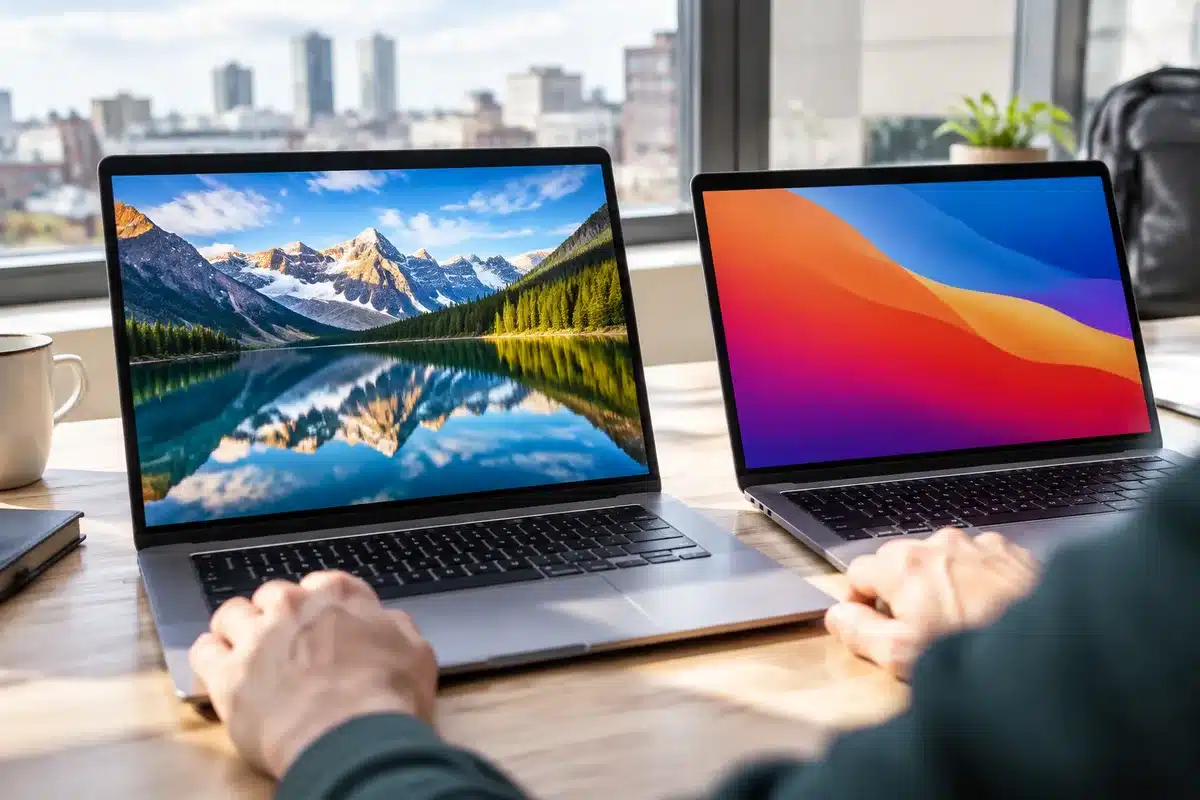
This fall Apple introduced MacBook Pro models featuring PROLED XDR displays, while keeping the existing Mini‑LED versions in its lineup. The new OLED machines carry a premium — roughly €400 extra for the 14‑inch and €500 for the 16‑inch — compared with identically configured Mini‑LED models. Here’s a rundown of what sets the two families apart.
Scientists confirm: This is the most effective way to get your cat’s attention, according to new research
Elderly Couple Refuses Reserved Seats—Viral Train Standoff Sparks Fiery Debate on Courtesy
Mini‑LED panel or OLED
The headline change on the MacBook Pro PROLED XDR is the move to OLED panels instead of the Mini‑LED screens Apple has used since 2021. OLED does away with a separate backlight: every pixel generates its own light and can switch off completely to produce true blacks. Mini‑LED narrowed that gap by using many small backlight zones that can be dimmed or turned off locally, but it can still show noticeable blooming — a faint glow surrounding very bright areas against dark backgrounds, visible for example on high‑contrast video such as fireworks.
Like the iPad Pro, Apple equips the PROLED XDR MacBook Pro with a Tandem OLED design, meaning two emissive layers. That approach lets the panel reach higher brightness levels while avoiding thermal issues and reducing the risk of burn‑in from long‑static content. The PROLED XDR maintains a sustained maximum brightness of 1,000 nits — the same baseline as the Mini‑LED models — but can hit peaks of up to 2,000 nits on HDR and even SDR content. Mini‑LED peaks top out around 1,600 nits and are restricted to HDR highlights. The OLED panel is thinner, consumes less power at equivalent brightness, and expands color support to include Adobe RGB in addition to Display P3.
Switching to OLED also allowed Apple to slightly enlarge the visible panels by trimming bezels. The 14.2‑inch configuration grows a little taller, moving from 3,024 x 1,964 pixels to 3,024 x 1,986 pixels. The larger model is now 16.3 inches instead of 16.2, with its resolution rising from 3,456 x 2,234 to 3,472 x 2,266. Another small aesthetic change: the lower corners of the Mini‑LED displays are squared off, whereas the OLED screens have rounded lower corners.

Notch or Dynamic Island
On the Mini‑LED MacBook Pros the front‑facing sensors live in a notch at the top of the panel. For the OLED models Apple replaced that notch with a Dynamic Island. This pill‑shaped area is narrower than the iPhone’s because the MacBook Pro lacks the Face ID hardware — it still uses Touch ID on the keyboard. Part of the display extends above the black pill.
As on iPhones, the Dynamic Island on the Mac serves as an interactive area: the black pill can expand to surface widgets, notifications or even the system search interface. The front optics sit inside that shaped cutout and can be visually integrated with UI elements placed on a black background.
Touchscreen
A major new capability of the PROLED XDR laptops is that the screen is touch‑sensitive. Apple modified many interface elements so macOS can be used directly with fingers, while preserving the system’s primary focus on trackpad, mouse and keyboard input. Touch is intended as an optional convenience — you can ignore or turn it off entirely if you prefer. Apple also strengthened the hinge on the PROLED XDR models to reduce panel flex when pressing the display.

Design, thinness and weight
The OLED update came with a chassis rework. Thanks to the slimmer panels and a revised thermal layout, the new machines are slightly thinner and more compact because the bezels have been narrowed. Thickness drops from 1.55 cm to 1.50 cm on the 14‑inch model, and from 1.68 cm to 1.60 cm on the 16‑inch. The 14‑inch footprint shrinks to 31.08 x 21.63 cm from 31.26 x 22.12 cm, and the 16‑inch goes to 35.55 x 24.42 cm from 35.57 x 24.81 cm. Those changes translate into meaningful weight savings: the 14‑inch falls from 1.60 kg to 1.38 kg (about 230 g lighter) and the 16‑inch from 2.14 kg to 1.82 kg (about 320 g lighter).
Another subtle design tweak: the Apple logo on the back of the lid is now illuminated on the PROLED XDR models. By default its brightness follows the screen, but it is driven by a distinct light source and can be turned off independently.
Why You Should Never Reheat These Foods in the Microwave – The Hidden Dangers Experts Warn About
I tried the top 5 guard dogs—here’s what makes these breeds the ultimate protectors
Speakers
Apple upgraded the speaker system on the PROLED XDR MacBook Pros. New woofers deliver roughly 50% deeper bass compared with the Mini‑LED machines, and the tweeters have been reworked for improved dispersion. There’s also a new software option to route audio through the built‑in speakers even with the lid closed.
Chips and connectivity in common
Under the hood both Mini‑LED and OLED MacBook Pros use the same M5 Pro and M5 Max processors, so raw performance levels are equivalent. The PROLED XDR’s revised cooling does allow those chips to be sustained at high performance longer, however. One distinction: the Mini‑LED line also offers a base model equipped with the standard M6 chip, an option not provided for the OLED models. Storage options differ slightly — PROLED XDR can be configured up to 16 TB, whereas the Mini‑LED tops out at 8 TB.
Battery life figures are unchanged: up to about 22 hours on the 14‑inch and up to 24 hours on the 16‑inch. Wireless and wired connectivity remain the same across both lines: Wi‑Fi 7, Bluetooth 6, three Thunderbolt 5 ports, HDMI, an SDXC card reader, MagSafe charging and a headphone jack.
Pricing
The Mini‑LED MacBook Pro family retains two practical advantages. First, there is an entry‑level Mini‑LED configuration that uses the M6 standard chip, pushing the starting price down to roughly €2,229 for a base 14‑inch with 16 GB RAM and a 1 TB SSD. Second, because the Mini‑LED models and their M5 variants have been on the market longer, retailers frequently discount them more aggressively. Apple’s official prices for the M5‑based Mini‑LED machines start at €2,899 for the 14‑inch and €3,399 for the 16‑inch (minimum spec: 24 GB RAM and 1 TB SSD).
The newer PROLED XDR models carry the premium: Apple’s list prices begin at €3,299 for the 14‑inch PROLED XDR and €3,899 for the 16‑inch, again with at least 24 GB of RAM and a 1 TB drive. Given their recent introduction, promotional discounts on the OLED machines are likely to be limited for several months compared with the older Mini‑LED offers.
Which model should you choose? Is it worth waiting?
The OLED PROLED XDR option adds about €400 for the 14‑inch and €500 for the 16‑inch versus the same M5‑based Mini‑LED configurations (before any promotions). If the advantages of OLED — deeper blacks, reduced blooming, higher peak brightness, slimmer construction and lower weight — matter to you, the extra cost is reasonable. Keep in mind, though, that since both lines share the M5 Pro and M5 Max chips, you won’t see a CPU/GPU performance jump simply by choosing OLED. It’s also unfortunate that Apple didn’t offer an OLED model with the standard M6 chip, because the roughly €1,000 gap between the base 14‑inch Mini‑LED and the entry‑level PROLED XDR can be hard to justify for many buyers.
If you can wait, there’s a credible argument for holding off until the next generational update expected in 2027. Apple has not released Pro or Max variants of the M6, so the next major leap should arrive with M7 Pro and M7 Max silicon — and those chips are expected to appear first in the OLED machines. Barring surprises, those refreshed OLED Pro models are unlikely before fall 2027. A separate, redesigned 14‑inch with a standard M7 chip could plausibly arrive around next summer.
Similar Posts
- MacBook Pro Update: Mini-LED and OLED to Coexist Until At Least 2028!
- MacBook Pro PROLED XDR: See How Its Cooling System Handles Heat
- MacBook Pro 2026-2027 Roadmap Revealed: What’s Next for Apple’s Powerhouse?
- MacBook Pro OLED: Reportedly significantly lighter
- Touchscreen MacBook Pro Debut: Apple Confirms Oct. 28 Event — What to Expect

Ethan Rivers focuses on Android smartphones, emerging mobile platforms, and operating systems. With a critical yet fair perspective, he evaluates devices on performance, design, and ecosystem compatibility.