
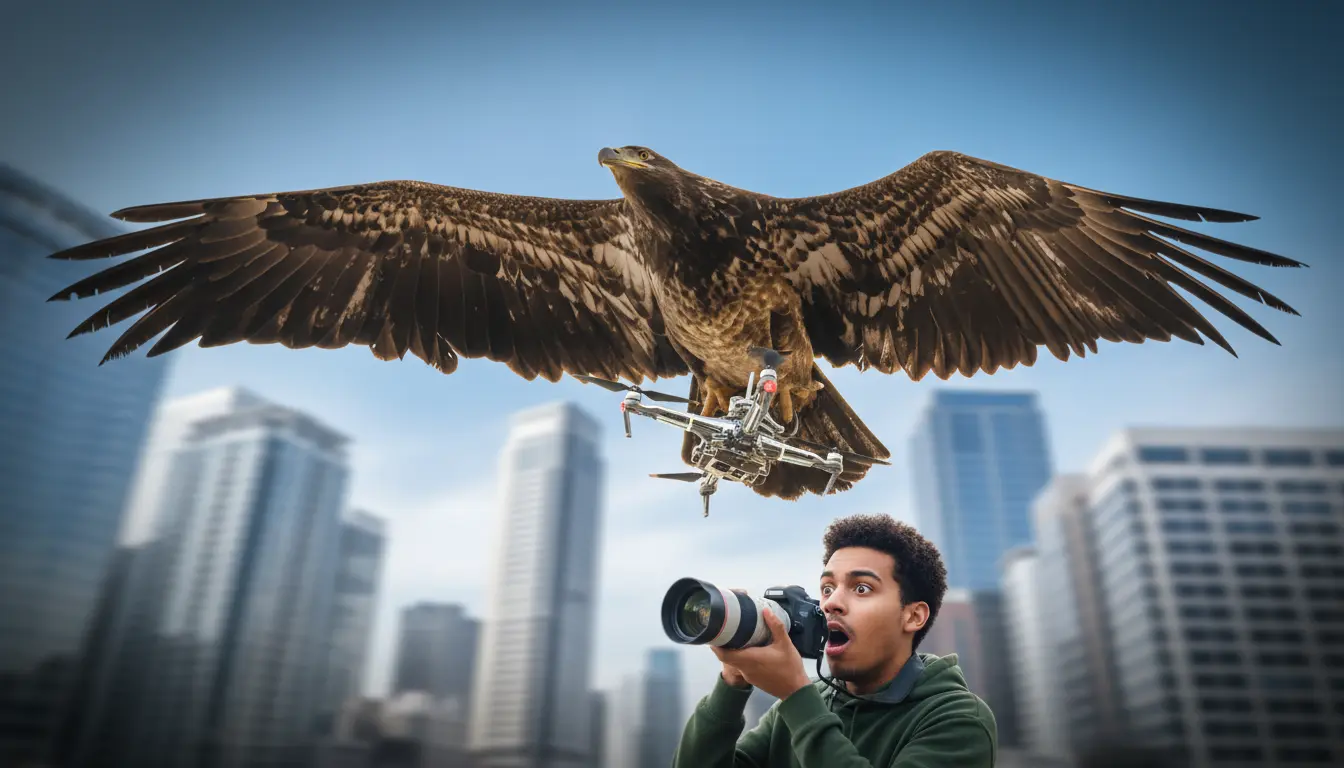
When wildlife photographer Doug Gemmell set out with his camera, he never expected urban nature to deliver such a twist. What started as a typical birdwatching outing swiftly transformed into an extraordinary moment—one that even seasoned observers must admit is rarely seen, and that left Gemmell, by his own account, in pure awe.
Scientists confirm: This is the most effective way to get your cat’s attention, according to new research
Elderly Couple Refuses Reserved Seats—Viral Train Standoff Sparks Fiery Debate on Courtesy
An Eagle’s Unlikely Urban Adventure
Gemmell, who regularly tracks and photographs birds of prey, was on a mission: to spot and capture images of a juvenile bald eagle, one of North America’s most majestic raptors. Typically, eagles are the epitome of wildness—lords of sky and lake. But when Gemmell saw his eagle on the wing, things took an unexpected turn. Rather than swooping toward water (the fish buffet that bald eagles are famous for), the bird’s flight path shifted: the eagle dove toward a parking lot. Not a river. Not a forest. A parking lot. Even Gemmell couldn’t have guessed what came next.
His curiosity piqued, Gemmell aimed his lens and kept snapping, chasing this odd detour. Only when he reflected on his photos afterward did he grasp the full absurdity of what he’d witnessed: the mighty eagle, talons locked around not a fish or a rabbit, but a slice of pepperoni pizza. Yes, you read that correctly—a true slice of life, New York style. No wonder Gemmell, recounting the story, chuckled: “It’s not something you see every day, that’s for sure.”
Natures’ Adaptability: Talons and Takeout
The image does more than spark laughter. It illustrates the remarkable adaptability of urban wildlife. Our cities are dotted with animals that have learned to turn our messes—leftovers, discarded food, occasional pepperoni pizza—into opportunity. While city dwellers may spot wildlife in parks or alleyways, the sight of a bald eagle scavenging in a concrete jungle is a strong symbol of the times.
- According to a 2021 study by the National Wildlife Federation, urban wildlife (including birds of prey) is adapting to city environments faster than researchers expected. That means more scavenging—garbage and discarded food are squarely on the menu for eagles and hawks these days.
- Another study from Cornell University found that bald eagles have increased their urban range in recent decades, likely because city regions teem with food: fish in urban waterways, small mammal populations, and, apparently, an abundance of questionable human cuisine.
Eagles, true to reputation, are powerful hunters with top-tier eyesight, able to sweep down from dizzying heights to take fish, mammals, or even carrion. Compared to elusive falcons, they might lack aerial agility, but their size, strength, and persistence make them formidable in the wild—even if their prey today features mozzarella and tomato sauce.
Urban Wildlife: When Survival Gets Innovative
The eagle in Gemmell’s photograph isn’t strictly following nature’s playbook. Its trip to the pizza parlor (or, more accurately, the parking lot) suggests adaptation in action: scarcity of natural food, combined with the bounty of human discards, nudges wildlife toward creative solutions. Was the bird genuinely hungry for pizza, or simply playing with an odd find? In the case of bald eagles, who strictly eat meat—they can’t properly digest bread or cheese—the latter seems more likely. But whatever the motivation, the image captures a broader truth: wildlife is fluid, resilient, and frankly irresistible when it throws us such curveballs.
This single moment encapsulates the shifting boundaries between wild spaces and encroaching human habitat. In cities, animals are forced to forage where the opportunity arises. City parks, parking lots, and abandoned corners transform into new hunting grounds. As Gemmell’s camera proves, nature finds a way—even if what it finds is a slice of pizza.
Reflections and Takeaways: The Unexpected at the Crossroads
Gemmell’s quirky and thought-provoking discovery isn’t just a great story—it’s a mirror, reflecting back the surprising evolution of the natural world in our modern age. Even the most iconic American bird isn’t immune to the unpredictable intersections between the animal kingdom and human life. The take-home message, wrapped in humor: never underestimate Mother Nature’s ability to adapt—and stay sharp, because you never know what you might glimpse when nature and civilization collide.
- Keep your eyes open for odd sights in unexpected places.
- Remember that urban wildlife is surviving, adapting, and sometimes just playing with their food (or ours).
In a world where pizza-loving eagles exist—at least for a moment—there’s always something new to discover, just around the corner (or the nearest parking lot).
Why You Should Never Reheat These Foods in the Microwave – The Hidden Dangers Experts Warn About
I tried the top 5 guard dogs—here’s what makes these breeds the ultimate protectors
Similar Posts
- Segway E250S Electric Review: Perfect Scooter Alternative to Escape Traffic Without Breaking the Bank!
- He reels in the catch of a lifetime: the monster alligator gar nobody thought possible!
- “You Won’t Believe What Happened When I Woke Up—A Wild Cheetah Chose Me for a Nap”
- Can You Spot All 5 Watermelons in This Tricky Brain Test? Most People Miss One!
- Marines Stunned by Unbelievable Encounter: Elephant Spotted 10 Miles Out at Sea

Jordan Park writes in-depth reviews and editorial opinion pieces for Touch Reviews. With a background in UI/UX design, Jordan offers a unique perspective on device usability and user experience across smartphones, tablets, and mobile software.