
Scientists confirm: This is the most effective way to get your cat’s attention, according to new research
Elderly Couple Refuses Reserved Seats—Viral Train Standoff Sparks Fiery Debate on Courtesy
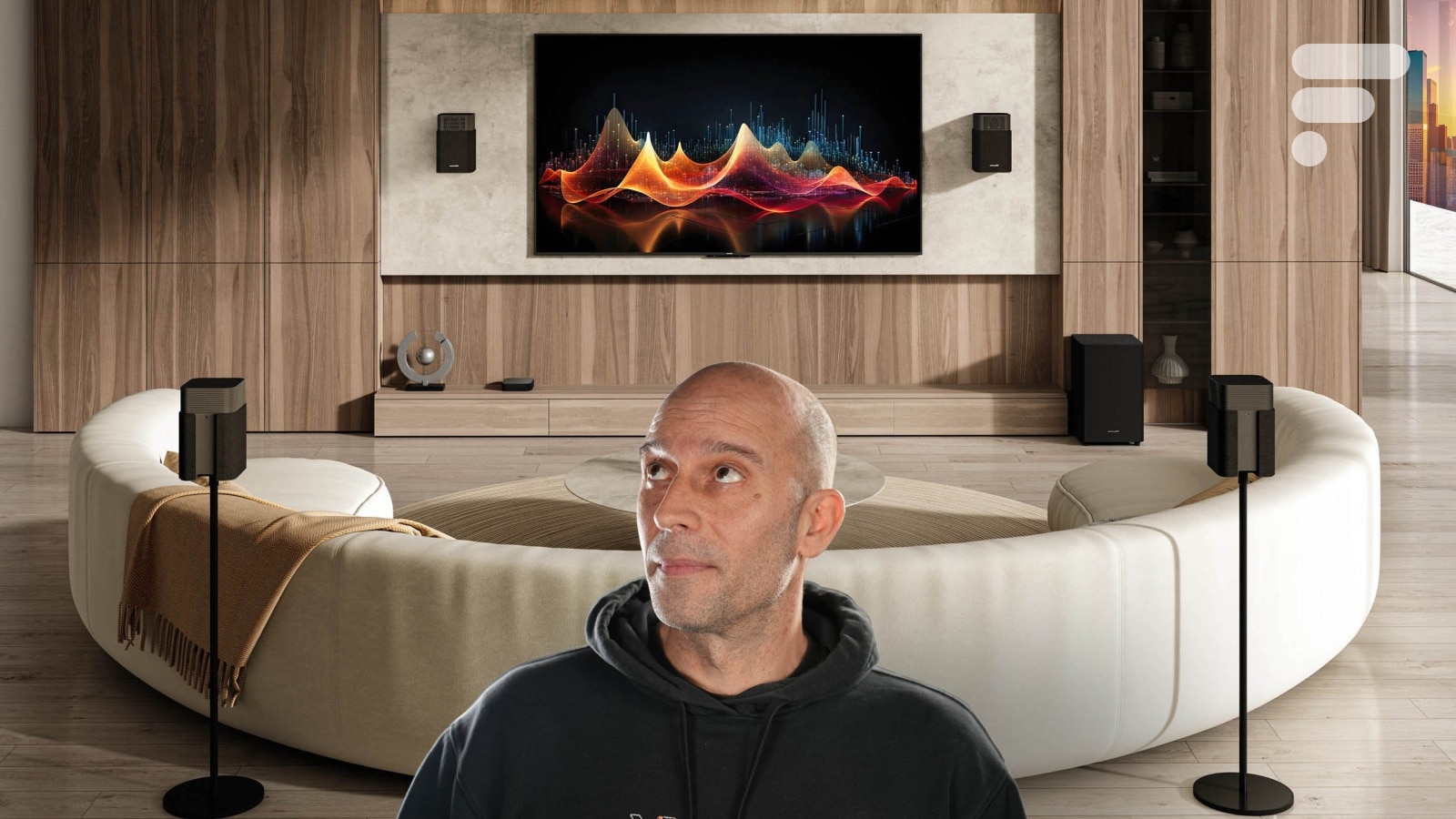
The Hisense HT Saturn is a high-end wireless home cinema system that features a 4.1.2 channel setup and a total power of 720 W. Developed in collaboration with Devialet for acoustic calibration, it consists of four compact satellite speakers and a subwoofer, all designed for discreet integration in a living room.
With its 13 speakers distributed among the satellites, including models dedicated to Dolby Atmos and DTS:X vertical effects, it aims to recreate an enveloping three-dimensional soundscape. The audio signal is wirelessly transmitted from a central unit connected to the video source, and each system component only requires a power outlet, significantly simplifying installation.
The HT Saturn offers several audio modes suitable for all uses (cinema, music, sports, gaming, AI) and complete connectivity (HDMI eARC, optical, Bluetooth) for a universal plug-and-play experience. It is truly designed for those seeking a 360-degree immersion without the clutter or complicated wiring. It directly competes with the Sony Bravia Theatre Quad system but also with more traditional setups such as the Samsung HW-Q995F, LG S95TR, JBL Bar 1300 MK2 soundbars, for instance. We have tested it, and here are our impressions.
Hisense HT SaturnTechnical Specifications
| Model | Hisense HT Saturn |
|---|---|
| Number of Channels | 4.1.2 |
| Power | 720 watts |
| Spatial Audio | Dolby Atmos, DTS:X |
| Number of HDMI Ports | 2 |
| HDMI e-ARC | Yes |
| Wifi | Unknown |
| Subwoofer | External |
| Rear Speakers | External |
| Product Sheet |
Hisense HT SaturnDesign and Installation
The Hisense HT Saturn features a distinctly contemporary design approach. Indeed, this system favors discretion and elegance over ostentation. Unlike traditional home cinema setups which are often bulky, this system opts for a minimalist aesthetic that naturally blends into all types of interiors, from modern living rooms to more classic spaces.
Aesthetically, the four satellite speakers are identical. They have a compact format: 122 x 196 x 122 mm and weigh just 1.53 kg each. These dimensions are significantly smaller than the large modules of the Sony Bravia Theatre Quad (nearly 30 cm tall) while still maintaining a certain presence. Their rectangular shape with rounded edges is pleasing to the eye, and the harmonious distribution of materials creates a rather sophisticated visual effect.
The lower part of each satellite, slightly wider, is almost entirely covered with a synthetic mesh fabric that hides the transducers. This textile surface, although not matching the finesse of premium metal grilles, adds a warm and quite modern touch. The upper section, in matte striped plastic, subtly contrasts with the textile base and discreetly houses the upward-facing speaker, essential for Dolby Atmos effects. Note the presence of a green light indicator on the upper front part, which can be dimmed or completely turned off.
The phrase “Tuned by Devialet,” in the form of a sticker also on the upper part, highlights the acoustic partnership between the Chinese and French brands. Note that our test model did not have this sticker, but we confirm that it is present on the systems sold.
The wireless subwoofer (240 x 390 x 240 mm, 5.2 kg) also opts for a certain discretion with clean lines and a matte black finish. Its contained proportions allow it to be easily placed next to a piece of furniture or in a corner of the room without visually cluttering the space.
Its construction, while commendable, remains within mid-range standards with a vinyl covering and a medium density that distinguishes it from more high-end subwoofers.
Finally, the central connectivity hub (118 x 27 x 118 mm) pushes minimalism to the extreme with its ultra-flat profile and clean lines. Its slightly striated base is the only decorative element of this component, designed to be completely forgettable, whether placed on a TV stand or, better, hidden behind the screen.
The speakers can be placed on flat surfaces or mounted on the wall thanks to the integrated inserts and the provided mounting system. Indeed, the only cable used for power takes advantage of a bent end to insert its plug vertically, not hindering the base of the speaker.
It’s worth mentioning that the components are not connected by cables, which simplifies the installation. It is only necessary to consider having wall outlets in all four corners of the room, or perhaps extensions to connect two speakers together, for example.
Continuing with the installation, it’s straightforward; each speaker has a small diagram underneath that indicates its correct position relative to the TV.
It’s simple, and just follow the instructions to install them in the right place. The subwoofer and hub are naturally positioned at the front. The pairing is immediate, requiring no specific action.
Hisense HT SaturnConnectivity
All the connections of the Hisense HT Saturn are grouped within the central unit, the true brain of the system. This command hub thus concentrates all inputs and outputs to centralize the distribution of the sound signal to the wireless speakers.
It first offers two HDMI 2.1 inputs compatible with 4K, allowing the simultaneous connection of a game console, a Blu-ray player, or a multimedia box, with full support for the audio return channel eARC via a dedicated HDMI output to the TV. This function allows for bidirectional sound transmission and synchronized volume control via the TV remote thanks to the CEC protocol. For older TVs or non-HDMI sources, an optical S/PDIF input ensures compatibility with the majority of digital audio equipment, while the presence of a USB port is solely for potential software updates.
The wireless connectivity relies on a stable and responsive Bluetooth 5.3 connection, for streaming music from a smartphone, tablet, or laptop, for example. However, the HT Saturn does not offer a Wi-Fi connection nor multiroom protocols like Chromecast or AirPlay. The link between the hub and the speakers is proprietary, with no latency.
The system is Hi-Concerto compatible. This means it can function in perfect synchronization with a TV or projector from the brand that supports this technology. In practice, the TV or projector speakers complement those of the HT Saturn for an even more enveloping and immersive sound. We were able to test this setup with the Hisense PT1 projector, and the result is particularly appealing, allowing for enjoyment of a very complete and impressive setup.
The Remote Control
The remote control that comes with the HT Saturn system is slightly more sophisticated than those usually found with such audio components. Indeed, it benefits from an LED screen on the upper part that allows you to see what you are doing: active audio mode, volume, channel settings, connection, and source status. It’s not backlit and a bit heavy, which isn’t a dealbreaker.
It allows you to select sources, manage volume, select the type of equalizer in action, adjust the light intensity, the bass, the treble, the level of dialogues, the subwoofer, and the surround speakers. Other settings are also accessible. In use, it is responsive and ergonomic.
While some soundbars or audio systems offer pairing with an app available for smartphones or tablets, this is not the case here.
Hisense HT SaturnInternal Architecture
The internal architecture of the Hisense HT Saturn is organized in a 4.1.2 channel configuration. It includes a total of thirteen transducers distributed among the four satellite speakers and the subwoofer, ensuring complete acoustic coverage on all axes.
More specifically, the satellite speakers incorporate three distinct speakers. On the front, there is a mid-bass woofer responsible for covering the main band of the sound spectrum, accompanied by a tweeter directed directly at the listener for the reproduction of highs and the detailed restitution of dialogues. These two transducers form the core of the frontal sound message, ensuring a balance between clarity and homogeneity. The third speaker, oriented upwards, is a wideband transducer specifically dedicated to the vertical effects of Dolby Atmos and DTS:X soundtracks.
Its mission is to project sound towards the ceiling to generate, by reflection, a realistic perception of elevation and vertical immersion. This technical choice, supported by Devialet digital processing, allows for the creation of a virtual sound dome enveloping the listener, without the need for ceiling speakers.
Given that the configuration is on 4.1.2 channels, the upward signal is identical between the front satellites and those operating at the rear, different from a 4.0.4 system (like the Sony Bravia Theatre Quad without a subwoofer hence the .0) which clearly differentiates the front and rear signals, always upwards.
All speakers are individually powered via internal integrated amplification and communicate wirelessly with the central hub. Each contributes to the system’s total power of 720 watts RMS, the exact distribution remaining, however, focused on the front channels to ensure the coherence of Atmos effects. The asymmetrical arrangement of the Atmos emission – concentrated on the front speakers, with the rear modules serving more for ambient field and surround coherence – was chosen to optimize the three-dimensional perception without unbalancing the scene.
As for the subwoofer, it adopts a classic but effective configuration with a single 16.5 cm long-excursion speaker mounted towards the floor, powered by a dedicated 280 watts RMS amplification. This woofer is tasked with reproducing the lowest frequencies, with an extension measured up to 40 Hz. Its orientation ensures a direct impact and homogeneous propagation of bass, while its compact closed format minimizes parasitic resonances.
There is also a rear-oriented bass-reflex system.
The interaction between the subwoofer and satellites is managed by a central DSP that handles the crossover frequency and phase, ensuring a smooth transition between the bass and mid-high registers.
The system, resulting from a collaboration with Devialet, benefits from an internal calibration called “RoomFitting Tuning,” which automatically adjusts each transducer’s response to the room’s acoustics.
Hisense HT SaturnListening Experience
Regarding the listening experience of the Hisense HT Saturn, the system is relatively impressive for the coherence and richness of its output, especially for such a compact wireless system. The three-dimensional spatialization enabled by the 4.1.2 channel architecture and the audio processing by Devialet create a true sound bubble where every effect, every voice, and every atmosphere naturally finds its place.
When watching 6 Underground (Netflix, Dolby Atmos), the HT Saturn unleashes its full power. The opening scene of the chase in Florence perfectly illustrates its capacity to handle dynamic movements in space: cars skim walls and explosions spread from left to right with surgical precision. The ceiling-oriented speakers effectively project vertical sounds — helicopters and debris seem to come from above, giving a striking sensation of height. The digital hub continuously adjusts the balance, and transitions remain smooth, without audible breaks.
During Top Gun: Maverick (Blu-ray Dolby Atmos), the low-altitude flight scene showcases the mastery of the subwoofer: the turbines roar with controlled and physical bass, enhancing the cinematic dimension without encroaching on the dialogues. Voices remain perfectly centered thanks to the Devialet calibration DSP, despite the absence of a dedicated center channel.
TV series also benefit from this mastery of the sound field. In House of the Dragon (HBO Max), whispered dialogues and background ambiances (crackling fire, rustling fabrics) enjoy exemplary spectral balance. The Saturn manages to maintain vocal clarity even in intense scenes, without artificially compressing the mids. In The Last of Us (Dolby Atmos), the spatialization of environmental sounds — pounding rain, shattered glass, anxious breathing — creates a palpable, almost physical tension. The immersion is total, with the sensation of depth and distance being extremely well-restored thanks to the coherent distribution between front and rear satellites.
In terms of music, the performance of the Hisense HT Saturn pleasantly surprises, although it reveals some typical limitations of cinema-oriented systems. When listening to Get Lucky by Daft Punk (FLAC 96 kHz, Bluetooth 5.3), the stage spreads widely with a very nice separation of instruments. The highs are airy, precise without aggressiveness, and the bass benefits from good support from the subwoofer, which maintains a clean attack even at high volume. However, on more acoustic tracks like Someone Like You by Adele, the restitution remains slightly analytical: the voices are clear, but the midrange lacks a slight supplement of warmth that only traditional hi-fi speakers can offer. The “Music” mode, however, adds further fluidity and a credible stereo placement, ideal for everyday listening.
In “Game” mode, tested on several titles via a PlayStation 5, the sensation of spatialization is impressive given the limited number of speakers. The footsteps of enemies, gunshots, and reverb effects are positioned with remarkable accuracy, offering a real sensory advantage. This is also the case in racing games, where one is immersed in a truly immersive bubble. There is no latency, and the response is instant to changes in sound direction.
Overall, the Hisense HT Saturn provides a coherent, immersive, and surprisingly homogeneous listening experience, whether for movies, TV series, or music, although video content is favored.
Hisense HT SaturnRelease Date and Price
The Hisense HT Saturn audio system has been available for a few months now for a price of around 1500 euros, significantly cheaper than the Sony Bravia Theater Quad which is delivered without a subwoofer, although it is possible to purchase one separately, adding to the expense. The Hisense system is priced similarly to the JBL Bar 1300 MK2 and a bit more expensive than the Samsung HW-Q995F and LG S95TR soundbar sets.
Hisense HT Saturn
at the best price
- Similar Posts
- TCL Z100 Review: Simple, Modular Home Cinema Speakers Offer True Immersion
- Sharp HT-SBW320 Review: Extreme Slimness at the Cost of Immersion
- Samsung Q995F Review: Experience 11.1.4 Channel Immersion and Musical Excellence!
- Sonos Sale Alert: Discounts on Speakers, Soundbars, Subwoofers & Headphones!
- Marshall Heston 120 Review: Iconic Style Meets Immersive Sound in This Soundbar!

Maya Singh is a senior editor covering tablets and hybrid devices. Her work explores how these tools reshape digital productivity and learning. She also contributes to feature editorials on emerging tech.